Showing posts sorted by relevance for query ANZAC. Sort by date Show all posts

Monday, 23 April 2018

A Poor Fit

Destroyed bridge - Song Rai - March 1970


Wednesday is ANZAC Day.

As usual, I'll be marching. I march to remember and honor the men I served with in Vietnam.

There is for me, a very poor match between my service in Vietnam, and the ANZAC story. With the wonderful hindsight that history provides, we understand now the political deception and sad futility that was characteristic of that conflict..

To state that - to put it out there - does not dishonour the diggers. They did their duty, and we owe them.

We also owe my father who fought in the RAAF in the New Guinea campaign, and my great uncle Clarrie, who served in France in WW1, and every other digger who enlisted or was conscripted.

It seems that there's a set of public statements about ANZAC Day that are acceptable, and anything not PC or departing from that creates outrage. Just ask Yassmin Abdel-Magied.

I'll take that risk, gentle reader. I'll make some non-PC comments, and to hell with the outrage.

After I returned from Vietnam, it was fifteen years before I marched on ANZAC Day. The first time was in 1985 only because I felt I owed a gesture of respect and thanks to the local RSL, who had donated $500 to my school. I was the principal of a Special School at the time.

I'm still not sure how they knew I had fought in Vietnam, as I had worked hard to keep it quiet. Being identified as a Vietnam veteran before the Welcome Home march in 1987 was not necessarily a good thing. 

Looking back, apart from avoiding the persisting public rejection and disregard of Vietnam veterans which pretty much began to evaporate in 1987, I hadn't marched because I felt my experience in Vietnam had very little to do with ANZAC Day. I still feel the same, but marching these days gives me the opportunity to share something with fellow ex-servicemen and women. Long Tan day (August 18th) has greater significance for me than ANZAC Day.

What we share on these days is difficult to put into words, but it revolves around mateship, compassion and pride. We were fighting for each other. The bond that develops around this shared experience is uniquely strong.

When you look at the ANZAC myth, and compare it with the reality that was Vietnam, I reckon my early misgivings were justified.

In the first place, I was a conscript. The ANZAC myth doesn't fit well with conscription.

I was a soldier not because I was sacrificing everything for Queen and Country, but because it was a better option than being jailed - hardly a noble motivation. If I had resisted my call-up, I would have fronted a magistrate and probably spent the next couple of years in Boggo Road. As a beginning teacher at the time, that would not have been a good career move. Teaching was incompatible with a criminal record.

Reality - poster - WW2
Rhetoric - poster - Vietnam


Our country was at peace at the time of my service. Unlike during WW2, there was no existential threat. There was no Imperial force at our doorstep. Darwin hadn't been bombed.

The relatively recent experience of WW2 was, however, cynically exploited by the politicians of the time. They needed those DLP preferences to hold on to power. Echoes of the "Yellow Peril" rhetoric used under threat of Japanese invasion were carefully resurrected during the Vietnam era. After all, the Vietnamese and Japanese were Asian. For the fearful and pig ignorant - that was enough.

Fighting in peacetime when there is no existential threat is not a good fit with the ANZAC myth.

Like it or not, I was part of an army of occupation. We were "invited" to participate only after the corrupt South Vietnamese government was pressured by our government at the time to do so. The ANZAC myth promotes the notion that we were fighting for freedom. The Australian people were sold that narrative in reference to Vietnam. 

I question that. I doubt very much that most Vietnamese at the time welcomed us. Given their history of resisting in sequence, the Japanese, the French and the Americans, welcoming Uc Da Lois would have been an historical aberration. All the Vietnamese wanted, after forty years of conflict, was peace.

Diggers in Vietnam maintained the ANZAC tradition in terms of how they conducted themselves. The same can't be said of our political leadership at the time - reference the poster displayed on the right above.

The ANZAC myth is rich with references to throwing out occupying armies, especially during the Pacific campaign. Along with most of SE Asia,  the Japanese occupied Vietnam for a while. Ironically, twenty years later, so did we. I wonder how that sits with the ANZAC story?

And of course, Vietnam became a lost cause. Mind you, so was Gallipoli, but at least the young men who fought so well during Churchill's excellent adventure, were volunteers. It's worth noting with the celebration of the centenary, the mythological attention seems to be morphing away from Gallipoli and towards the Western front. The myth is obviously malleable.

Not only is the myth malleable; it is also corruptible. A few years ago, I was asked to deliver an ANZAC Day address at my old high school. I researched the task thoroughly. After all, as a teacher, I wanted to deliver something engaging, but most importantly, historically accurate.

To my amazement, when I visited the ANZAC Day commemoration website, I discovered that I had actually volunteered to fight in Vietnam. This did not sit well with my recollection, nor, as it happens, with the National Service Act.

I phoned the Commemoration Committee number as advertised on their website, and was told that my memory was wrong, and that every Nasho who served in Vietnam was given the chance to escape service in Vietnam in what were called "opt-out" parades. 

I found that revelation amazing, as I was never present at an "opt-out" parade. When I asked the men from my rifle section if they had participated in such a parade, their memories concurred with mine. Perhaps my unit (7 RAR) was exceptional?

I then went to the AWM website and checked the record. If you have enough time and motivation, every CO's parade is recorded and you can check the detail. No "opt-out" parades were recorded for my unit in the six months prior to embarkation, so I began to check other Infantry units.

After many hours, and much frustrating searching, I found no reference to such parades and gave up.

Subsequently, Mark Dapin's work which has debunked so many romantic generalisations has clarified the range of experiences of Nashos. What he has written has pretty much confirmed my recollection, but there are diehards who continue to maintain the opt-out myth. The Commemoration Committee has not corrected the record.

The campaigns in Iraq and Afghanistan sit better with ANZAC than Vietnam, as do the various peacekeeping actions, mainly because ADF members were volunteers. Iraq is a stretch. The invasion of Iraq was justified by a lie after all, but that does not diminish the sacrifice of the diggers. 

In summary, our involvement in Vietnam has four characteristics at odds with the ANZAC myth. 

We were part of an army of occupation.

It was peacetime.

Many of us were conscripts.

Vietnam was foreign soil.

Admittedly, some of the other conflicts had elements of these characteristics, but all of them?

Vietnam was a sad anomaly.

It's worth acknowledging that the Chocos who fought so well on the Kokoda track were also conscripts, but they were fighting in Australian mandated territory. Vietnam was not that. 

By the time I was there, victory was a lost cause, a reality that the US administration knew and understood, even as they continued to send conscripts to fight and die. You could be charitable and believe that our government at the time was not aware of the import of the Pentagon papers, but a call-up that avoided political blowback by taking a small proportion of young men was far from charitable.

None of these four exceptional factors characterising the Vietnam conflict sit well with the myth of noble self-sacrifice, or with the Australian experience of other wars.  

So I will continue to march, but but I will do so as as a mark of respect towards my fellow ex-servicemen and women. I will remember those who did not survive, and march with those who did.

I will march with a mix of sorrow and anger, and with the fervent hope that there will be no more Vietnams.


Monday, 1 May 2017

ANZAC - Myth & Reality


First Op - March 1970 - Yours truly standing (R)


Thailand is a beautiful and tolerant land, but watch that tolerance evaporate if you criticise the royal family.

A few visiting Australians have discovered that.

This country also has a reputation for easy going tolerance, but there are some mythologies that are so powerful, that challenging them is not for the faint-hearted. The Anzac Myth is one of those.

Just ask Yassmin Abdel-Magied. 

She had the temerity (or perhaps the effrontery) to use the phrase ‘lest we forget’ in reference to asylum seekers and Syrians on Anzac Day.

That was nearly a week ago, and the howls of outrage continue to reverberate. What she posted was at most insensitive, and at least careless, but it created such a tidal wave of offence taken, that something more than bizarre has been revealed in our national psyche. 

We heard (in quick succession), calls for her to be sacked and/or deported, and the abusive pile-on was taken up by shock jocks and opinionistas all over the place. Apparently, it caused deep offence. It did not offend me. Nor as far as I can tell did it offend the ex-service personnel I marched with on the One Day of the Year.

The conversation in the ranks when I marched on Anzac Day was not about Abdel-Magied. We put shit on each other as we usually do, inquired about the health of those not fit enough to march, and made comment about the flyover.

It was a very good flyover in our provincial city this this year, nine choppers (Kiowas, Tigers and MRH-90s) in groups of three flew over the memorial during the service. There weren’t any Iroquois – they’re all decommissioned, but the Kiowas with their two-blade rotors do pretty good Huey impressions if you close your eyes and listen to the sound.

But I digress….

I shouldn’t have been surprised – about the reaction to Abdel-Magied’s post, that is.

Let me say up front that Anzac Day is for me, very important. 

For a hiatus of fifteen years post-Vietnam, like many other Nashos, I ignored the commemoration. Somehow, marching with the other returned service men and women (including my father) didn’t seem right, when both the war and those who fought in it were treated with disregard because it culminated in a defeat for the side we supported. We were, for a while, airbrushed out of the history.

The “Welcome Home” march in 1987 seemed to change that.

These days I always march, and have traveled as far as Sydney to do so with members of my rifle platoon. There are no members of my unit living in home city, so marching here lacks something. I did, however, encounter an ex-Nasho who marched for the first time last week. For him and his family, this crossing of the threshold of grief and bitterness was very important.

I would be the first to admonish anyone whom I believed was dishonouring the memory of the people I served with, but Abdel-Magied’s brain snap wasn’t doing that.

She was, like many Australians including myself, expressing shame at the cruelty inflicted on asylum-seekers (or country shoppers if you like) who are locked up offshore without any real future. She was also referring to the millions in Syria who have been dispossessed by the conflict there, a conflict whose roots lie in serious historical miscalculations by our allies and our governments in 2003.

What I find much more offensive than an ill-considered Facebook post, are the many venues, holiday accommodations and sporting clubs who exploit Anzac Day to improve their bottom line. One motel in Brisbane was running an  “Anzac Weekend” accommodation campaign with intensive TV ads for about a week during the lead up. 

Much of this exploitation seems to be tolerated. If I was cynical I’d assume that gender and religion had something to do with the pile-on directed at Abdel-Magied.

But I’m not cynical. What set the hounds baying here was a perceived attack on the myth.

By way of explanation, I’ll recount a personal encounter with the mythology that is happening as I write.

I was invited to give a talk on Anzac Day at my old school, Downlands College. I prepared diligently, researching the Anzac Day commemoration website.

On that page I came across the statement - "But there were probably few, if any, who were actually forced to go to Vietnam".  I found this passing strange, given that my experience and that of most of the men in my intake was very different.

As a teacher, what is on that website is not good enough for me. If we are developing resources to be used in schools, (and that is the purpose of the website) those resources need to be accurate. Anything else is indoctrination.

I began to do some research of my own through the Australian War Memorial. The anecdote trotted out most frequently to support the “every Nasho was a volunteer” narrative talks about “opt-out parades”. 

It goes like this – prior to embarkation, a unit parade of National Servicemen would be called and those who did not want to serve in Vietnam would be asked to take one pace forward. If they did so, they would be marched out to join a unit not warned for Vietnam service.

I had no memory of this, and the Nashos I served with, although they had heard the story, vowed that it had never happened to them. I then began the arduous task of ploughing through the battalion records held on-line at the AWM. Every parade, including those held prior to embarkation, was recorded for every infantry unit.

Nowhere was there a record of such a parade. I gave up after looking through the parade records of four of the nine battalions in existence at the time. It was an entirely fruitless search.

This is hardly surprising. If these parades had been held, the Commanding Officer of the unit in question would have been in breach of the National Service Act. Perhaps there were “unofficial” parades mounted by some units – but to say that “every” Nasho was a volunteer is simply not truthful.

“Every” means “without exception”.

Armed with this evidence, I wrote to the secretary of the commemoration committee and inquired as to the source of that information.

As this is written, I have an email acknowledgement which reads - 

Thank you for bringing this to our attention. Our researchers are looking into it and appropriate action will be taken.

I'll keep you posted.

The reason for this variation from the reality and the insertion of it in a resource intended for school use is, I believe, caught up in the Anzac myth. The notion of noble sacrifice doesn’t sit well with conscription, so conscripts become “volunteers”. It adds a layer of sweetening to help the harsh medicine go down. 

Until we embrace the reality of our history, warts and all, our nation will not develop beyond its adolescence. That reality saw Australian conscripts killed in Vietnam.

To deny that truth dishonours those men. It assumes that there was a distinction in the field between Nashos and volunteers, and that the service of Nashos was somehow less honourable because they did not volunteer.

Why else would the myth seek to convert us to volunteers?

When it come to the Anzac myth, it’s time we grew up and confronted the reality of war in all its ugliness. Truth and remembrance go hand in hand.

Saturday, 25 April 2015

ANZAC Day

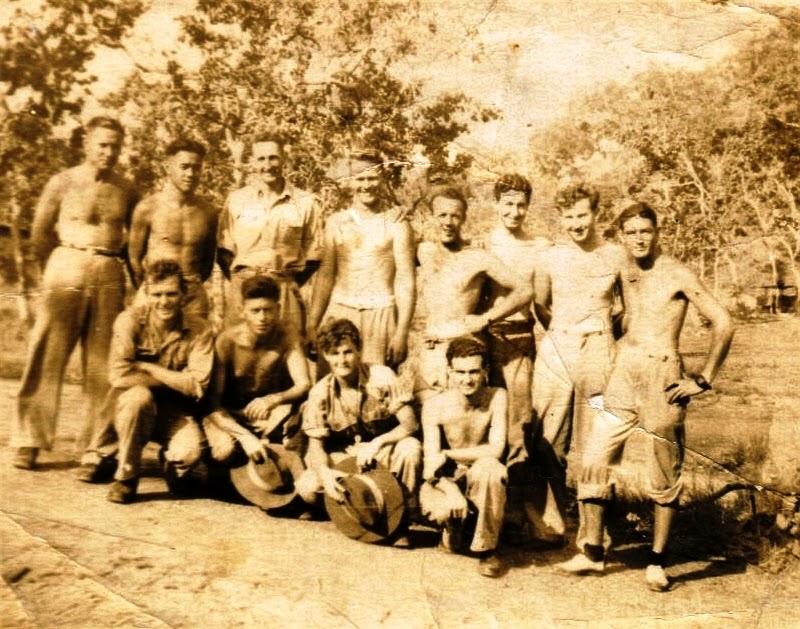
Dad in New Guinea (Front row - second from left).


On the centenary of the Gallipoli landings, everyone is making declarations about their understanding of the meaning of ANZAC.

So who am I to presume to be different?

Frankly, my association with and view of ANZAC Day has changed substantially through the years.

When I was a kid, it meant joining my mates in marching a short distance to a ceremony in front of memorials in bush townships. My dad would also march wearing his medals.

When I was that age (primary school) dad was working his way up the seniority ladder as principal of a number of small bush schools.

Dad was a returned airman (RAAF - New Guinea) and an RSL member, and as the local schoolie he was always involved in the organisation of the day. I don't recall him holding any great enthusiasm for the commemoration, but he was always there - almost with a sense of resignation.

He never went drinking after the ceremony as I recall. Many of his contemporaries did, and I remember as a kid, feeling indignant about this. To me it seemed disrespectful.

Perhaps it was this that caused me to lose interest and become hostile to the concept, as for a time, in teenage and my twenties I did just that.

When I was called up, I hadn't been to an ANZAC Day commemoration for years, and this didn't change after Vietnam. If anything, my experience as a conscript reinforced my rejection of the myth.

I also sensed the hostility at the time to Vietnam veterans who were vilified by both the Left and Right of politics - the Left for fighting - the Right for "losing". I remember wondering why Gallipoli (a defeat and withdrawal) was glorious, and Vietnam shameful. Those in the community less politically aware compromised by indifference.   

I had also become intensely aware of the credibility gap between the myth and the reality.

In 1985, I was the Principal of Petrie Special School (a school that no longer exists). The local RSL presented a cheque to the school, and I was asked to accept it at a ceremony on ANZAC Day.

The local secretary discovered I was Vietnam veteran and asked me why I wasn't marching. I didn't really have an answer, and it would have looked churlish not to, so for the first time in years, I participated.

The Welcome Home march happened a few years later, and the attitude to Vietnam veterans changed from disregard and hostility to grudging respect.

 Since then, I have always marched. It means more to me if I can join the men from my section and platoon, and that's not possible at home, so I sometimes travel to Brisbane, and on one occasion drove to Sydney.

It is to me, and to these men, an important day. Yet we are acutely conscious of the fickle nature of community support for veterans.

Last night I watched a documentary about the Australian Light Horse in World War one. There was a great deal of grief and bitterness expressed by members of this renowned unit when their strong and loyal horses were put down prior to returning home.

The cost of returning the horses could not, apparently, be justified. Of the 39000 who served with the AIF, only one Waler is known to have been returned to Australia; "Sandy", the mount of Major-General W T Bridges, an officer who was killed at Gallipoli in May 1915.

A member of the Light Horse was quoted as saying that there was no consideration of cost in the decision to send the horses to Egypt in the first place, so why was it an issue after they had done their duty?

I recalled having to pay my air fare from Sydney to Brisbane on my return to Australia in 1970, whereas the army was quite content to fly me and my compatriots to Singleton on callup.

Not much, it seems, has changed - whether it's soldiers or horses. Both remain collateral.

So on ANZAC Day, let's continue to honour the dead. But let's also continue to fight like hell for the living. Based on the history, we can't assume community or government will do that.

Wednesday, 4 June 2025

Malice or Bitterness?

Pic courtesy CAWA

No doubt, gentle reader, you came across the reporting of shouts of abuse directed at a Welcome to Country introducing this year's Anzac Day dawn service at Melbourne's Shrine of Remembrance, and at a similar ceremony at King's Park in Perth.

It seems that there was a degree of organisation behind the Melbourne disruption, but the Perth incident was not planned.

Cries of outrage were heard from a range of sources, both directed towards the disruptions, and the place of Welcome to Country rituals at Anzac Day commemorations generally. Ex-service community social media networks lit up, again displaying strong feelings and abysmal ignorance.

The controversy highlights currents of malicious chauvinism that have simmered below the surface in this country for at least a century.  

The first of these currents relates to Anzac Day. The day is simply a commemoration after all. It is not a celebration of national pride, or a glorification of the warrior class - whatever that is. The men who died are not honoured by the screams of outrage directed at the inclusion of Welcome to Country ceremonies. Their memory is demeaned by it.

Anzac Day belongs to the whole nation, and is essentially an inclusive tradition. Welcoming attendees to a dawn service is simply a manifestation of this.  

The ignorance revealed by objections to all Welcome to Country ceremonies, not just those on Anzac Day, is another issue entirely. In the first place, given that indigenous Australians comprised over five hundred  distinct clan groups, welcoming people to country occupied historically by that clan by an elder is an entirely authentic process.

 "Country" does not refer to Australia in this context, something entirely ignored by those who mistakenly believe they are being welcomed to 2025 Australia. Various ex-service organisations made a virtue of declaring that nobody had the right to welcome them to the country they had fought for, completely forgetting that none of these clans have ever claimed to represent the whole country.

Then there are those who take offence because the elders who conduct the ceremonies are usually paid for the privilege. I find that strange, given that one of the hallmarks of a successful capitalist community is its willingness to pay for ritualistic expressions of symbolism. 

It matters not whether putting money into a collection plate at a church service or paying for admission to a football match is payment for witnessing a form of social ritual, these practices are very much part of contemporary mores and have been for a long time.

Frankly, I believe that anyone who would object to a gesture of welcome has been very poorly brought up. As my mother would have said if she had been alive to witness these objections - "They need to grow up!"


Sunday, 24 April 2016

The Anzac Myth

Photo courtesy the Saturday Paper


I came across this well written piece in The Saturday Paper.

It is especially relevant at this time, on the eve of ANZAC day, given the extensive and overblown mythology that has developed around what was always intended as a day of commemoration.

It also resonates with some research I did recently through the Australian War Memorial into a great uncle who served in France.

My great uncle's military records indicate that he jumped ship in Durban on the way to Plymouth, and was consequently separated from his unit. On arrival in the UK, he went straight into hospital with VD, no doubt picked up during the ten days he was AWOL in Durban.

His service records show that he embarked for France a few months later after a long stint in hospital, but the fact that he ended up with a different posting in a different unit from his original probably saved his life. More than half of his original unit were casualties, dead or maimed, in the nightmare that was the Western Front..

He survived and ended up marrying a French girl who had nursed him in hospital, strangely in the UK. I never did discover what she was doing in England.

They lived in France for a while after the war, but eventually found their way back to Australia in the twenties to settle in Clermont,central Queensland.

He died fairly young, possibly as a consequence of his service, but my French great aunt lived to a ripe old age. Stories of her eccentricities are part of our family history.

The article linked above discusses these issues at some length. It recounts the reality, not the myth.

Somehow the myth continues to grow, like a parasite on the truth, and it dishonours the memory of those who did not return.

On a personal note, I have been accused on a military blog of lying because I had the temerity to point out that the story going around that all Nashos who served in Vietnam were volunteers was rubbish. Somehow, the fact that National Servicemen were obliged to serve in Vietnam whether they wanted to or not, does not fit the narrative that we were enthusiastic about driving the Commies out of South Vietnam.

The National Service Act made it very clear that national servicemen on full-time duty were liable for ‘special overseas service’ including combat duties in Vietnam. This fact is conveniently ignored. The "all were volunteers" myth has been thoroughly debunked in mark Dapin's book - The Nasho's War, and before its release, research I'd done at the AWM was leading me to the same conclusion. There is no record of alleged "opt-out parades" anywhere in unit records or AWM documentation.

There may have been isolated incidents of unit commanders taking matters into their own hands and finding ways of weeding out unwilling conscripts, but I certainly was never given the opportunity. To enlarge this alleged practice to cover ALL Nashos is pure fiction.  

Dapin interviewed hundreds of Nashos and came to the same conclusion.  

The myth persists, and until a short time ago was included in material available to schools on the ANZAC day website. I emailed them with my evidence, but was ignored. My email remains unacknowledged.

Those who served were on the whole, ordinary men caught up in the absurdity of war. They wanted to live - they saw no glory in dying in war. They loved and were loved. They who were killed left family and lovers behind who will mourn them forever. 

Perhaps telling the truth about the ugly absurdity of modern warfare is too much for our delicate twenty-first century sensibilities, but is it OK to invent a false narrative to avoid such unpleasantness?

Update - As of 6th August 2018, and in response to further emails and a phone call, the ANZAC Day Commemoration Committee has amended their website and removed the reference to all Nashos being volunteers.


Saturday, 3 June 2023

BRS and the ANZAC Myth

Pic courtesy Canberra Times


It's been a little quiet here lately, gentle reader.

A 30,000 word thesis deadline was hanging over my head, which has now been met, so back to normal posting..... 

 The media is wall-to-wall Ben Roberts-Smith, at the moment. It sells well as a story because it brings together so much of what causes outrage, and outrage always sells.

Personally, I feel some sympathy for Roberts-Smith, not because I believe he has been accused unjustly, I simply don't know, but because he's collateral in the culture wars. Soldiers are always collateral, of course, as any Vietnam veteran will tell you. 

 There are so many aspects of this issue which are tragic. The rate of suicide amongst Australian veterans of Afghanistan is the first aspect of the tragedy. Then there's the issue of the reputations of the ADF and the SAS. 

When I was in what we called the "Funny Country", the SAS were held in awe. We had little to do with them, and they were largely invisible to friend and foe alike at the time, and they would always avoid a fight if possible. 

 Fighting wasn't really their role. They were essentially involved in collecting intelligence, and they were very good at it. 

They seem to have been used in a very different way in Afghanistan which brought them into contact with civilians. Some units seemed to have gone feral. This may have come about because their own culture has always seen them as a race apart and they made up rules as they went along. It's difficult to understand how higher command turned a blind eye to this, but it's apparent, by the outcome, that they did. 

Accountability needs to go all the way up the line, and this doesn't seem to be happening. 

 Then there's the ANZAC myth, as distinct from the ANZAC tradition. The myth holds that Australians in uniform can do no wrong, and if they are fighting for King and Country, they're somehow excused from accountability. The problem with this notion is, that if accepted, it brings our fighting men and women down to the same level as those who would use terrorism and intimidation to achieve their ends. That simply won't wash. 

Heaven help anyone who is critical of aspects of the myth.

The best aspects of the ANZAC tradition uphold compassion, a fair go, and the capacity not to take ourselves too seriously. The last aspect is what makes us so different from the Americans, something which was very obvious in Vietnam all those years ago. 

 The media need to let go of this story, as it harms all those involved, especially the soldiers who served, and their families. There's a whiff of stereotyping wrapped up in this, redolent of the "baby-killer" meme which did the rounds post Vietnam. This doesn't mean the media shouldn't report it, but they should not exploit it. That seems to be something that local media can't avoid.

Accountability needs to be applied, but doing so in the full glare of publicity, to sell clics and newspapers will do more harm than good, and enough harm has been done already, both in Afghanistan and back home in Australia.

Tuesday, 7 August 2018

Setting the Record Straight

Embarking - Feb 1970

Regular readers will perhaps remember this post about the ANZAC Day Commemoration Committee website.

You'll recall that I took exception to the statement that "every National Serviceman who served in Vietnam was effectively a volunteer".

This did not accord with my memory, and the "every" reference was frankly bullshit.

More fascinating was the reason for promoting this myth. My belief is that it is was a convenient rationalisation in an attempt to make our dodgy commitment in Vietnam somehow line up with the ANZAC myth.

Now I'm a pig-headed old curmudgeon, so I decided I'd have another go at asking the Committee to correct the record on the website. 

I emailed, as I had before, but this time followed the email up with a phone call.  I used this strategy  when I was a school principal dealing with bureaucracy. It almost always worked.

The person who answered the phone was, I think, a receptionist, but she obviously passed my concerns on to those in the committee who have the power to amend the website.

Yesterday, this email arrived -   

Dear Mr ******

Further to my correspondence of 26 July, I wish to advise that the statement on our website concerning the “generally voluntary” nature of the service by National Servicemen in Vietnam has been removed. After further consultation and research I concluded that the evidence presented by Mark Dapin in his book on Vietnam appears to be the most definitive presented on the subject and that the statements presented on our website appear to be erroneous – certainly in the experience of most Nashos.

Again, I apologise for any unintended offence or umbrage our website may have caused you or others. I appreciate you communicating your concern.

Sincerely

Colonel David Smith AM (Retd)
Hon President
ADCC (Qld)

This was gratifying. I'm glad that the primary website used by schools to develop teaching units about ANZAC Day is now promoting fact rather than myth.

The original email I sent reads thus -

Subject: Myths about Vietnam - please acknowledge

Dear Sir

I draw your attention to this statement on your website – https://anzacday.org.au/tackling-some-myths-and-misunderstandings-of-the-vietnam-war

After their initial training all recruits were allocated to a Corps (branch of the Army, eg Infantry, Artillery) for specialised training, and were then sent to particular units. If the unit was scheduled to be sent to Vietnam, the soldiers were generally given the chance to avoid transfer elsewhere. The Army's rationale was that in combat every man had to be able to rely totally on his mates, and any reluctant soldiers would endanger the whole group.

This statement is untrue, and should be removed from your website. I discovered it when, as a Vietnam Veteran, I was preparing an address to students at my old school, Downlands College (Toowoomba). My address was dedicated to Francis Topp, a friend I knew from my time at the school who was killed in the battle of Long Tan. I was seeking an accurate account of Australia’s history in Vietnam. 

I served as a conscript, in 7th Battalion, Royal Australian Regiment in its second tour of duty in South Vietnam in 1970.  I have no memory of being given a choice. There has been a myth circulated. It goes like this – prior to embarkation, a unit parade of National Servicemen would be called and those who did not want to serve in Vietnam would be asked to take one pace forward. If they did so, they would be marched out to join a unit not warned for Vietnam service.

The Nashos I served with, although they had heard this account, vowed that it had never happened to them. I have searched infantry battalion records held on-line at the AWM. Every parade, including those held prior to embarkation, was recorded for every infantry unit - https://www.awm.gov.au/collection/RCDIG1029063/

Nowhere is there a record of such a parade. I gave up after looking through the parade records of four of the nine battalions in existence at the time. It was an entirely fruitless search.

This is hardly surprising. If these parades had been held, the Commanding Officer of the unit in question would have been in breach of the National Service Act - https://www.legislation.gov.au/Details/C1965A00052

Perhaps there were “unofficial” parades mounted by some units – but to say that the soldiers were “generally” given the chance to avoid service in Vietnam is at least misleading, and at most a lie.

“Generally” means “mostly”, or perhaps, “more often than not”, or perhaps that it was common practice. This contention is simply not supported by the available historical evidence. It certainly doesn’t sit with my experience, or that of the many Nashos I have discussed the issue with down through the years. It is also debunked in Mark Dapin’s Vietnam, The Nashos War – https://penguin.com.au/books/the-nashos-war-australias-national-servicemen-and-vietnam-97806700

It has no place on a website used by schools to educate young Australians about our proud military history. As a school principal for many years before retirement, I understand the difference between indoctrination and education.

The reason for this variation from the reality and the insertion of it in a resource intended for school use is, I believe, caught up in the Anzac myth. The notion of noble sacrifice doesn’t sit well with conscription, so conscripts become “volunteers”. It adds a layer of sweetening to help the harsh medicine go down.

Until we embrace the reality of our history, warts and all, our nation will not develop beyond its adolescence. That reality saw Australian conscripts killed in Vietnam. I saw a couple of them die.

To deny that truth dishonours those men. It assumes that there was a distinction in the field between Nashos and volunteers, and that the service of Nashos was somehow less honourable because they did not volunteer.

Why else would the myth seek to convert us to volunteers?

When it come to the ANZAC myth, it’s time we grew up and confronted the reality of war in all its ugliness. Truth and remembrance go hand in hand.

I am therefore respectfully asking you to edit your website and amend it to reflect the facts of history. Simply remove that offending statement.

To do otherwise would be to disrespect my service, and those Nashos I served with. We were not volunteers, but we were good soldiers. We made the most of what life presented us, and did our duty.

Respect us with the facts.

Yours in remembrance.


Thursday, 29 April 2010

Anzac Day


This is a copy of an address I gave to students of my old school to commemorate Anzac Day last year. I'll post it now - better late than never.

Anzac Day Address – 24th April 2009

Young men and women of Downlands, distinguished guests staff and visitors.
 

Tomorrow is Anzac Day, and represents the 94th anniversary of the landing at Gallipoli.

It’s also 93 years since the Battle of the Somme, 68 years since the invasion of Crete, and the Siege of Tobruk, 67 years since the battle for Australia on the Kokoda Track, 58 years (to the day), since Kapyong in Korea, and 43 years since the Battle of Long Tan in Vietnam.


Today as I speak, Australian men and women are serving in Iraq and Afghanistan. There are also peacekeeping deployments currently in Cyprus, the Middle East, in East Timor, the Solomons, Sudan and Darfur.


Tomorrow we commemorate the sacrifice and contribution sailors, soldiers, airmen and nurses, made and continue to make to our country’s security. This sacrifice and contribution has become a legend.


Today I would like to share with you some of the realities behind this legend, by telling two stories about people whose lives held a personal significance for me. I am happy to acknowledge the legend, and all that is made of it through the media, but I also feel strongly that the reality is much more significant than the legend.

Please come with me on these two brief journeys.

Back in 1961, a 14 year-old boy left his home in North Eton, outside Mackay, and traveled the one thousand or so kilometers to attend boarding school in Toowoomba. The school was Downlands, and the 14 year-old was me.

It was the first time I’d been away from home, and as a boy from the bush initially I was lonely and homesick. Downlands was a very different place back then, a pretty tough environment.

During my first six months at Downlands, another young boy from the bush was very good to me, and used his straightforward sense of humour to cheer me up when I felt down. He was also good to have around on the few occasions when I copped a bit of teasing.

He was from Flagstone Creek, like me a boy from the bush, and his name was Frank. Before too long I had made friends and began to enjoy school, but I remember well Frank’s friendship and support when I needed it most.

He left Downlands six months after I arrived, and subsequently joined the army as soon as he was old enough, and did his recruit training at Kapooka. Frank’s family (he was the eldest of six) drove down in their Ford Customline to attend his passing out parade. His parents were very proud of their soldier son. His corps posting was Ordinance.

After Frank had been in the army for a few years he applied for a reposting to Infantry, and this happened in 1965. He went home for Christmas leave that year, and then returned to Sydney as a reinforcement. Eight months later, he was in Vietnam, and on the morning of 18th August, 1966, he joined Delta Company 6RAR.

By 4 o’clock that same afternoon, Frank was dead.

He was one of the first casualties in the Battle of Long Tan, when an Australian Company of about 100 men held out against an enemy force, estimated at least at 1500, until relieved by a company of Infantry mounted in Armoured Personnel Carriers.

This easy going compassionate boy from the bush had given his life for his country. Frank is buried in the Catholic cemetery at Helidon. He is remembered well by his large family, and his mother Bridget has been a guest here at commemorations, most recently at the dedication of a plaque in Frank’s memory in the refectory.

My second story is about the Head Teacher of Hampton State School in 1941. This young man had married in 1939, to a pretty young teacher he’d met at Clermont, and they had moved to Hampton when he was transferred there. As a married woman, his new bride had to resign as a permanent teacher, but when her husband enlisted in the RAAF in late 1941, she was temporally re-employed to act as Head Teacher at Hampton whilst he went off to war.

This young man was my father, and Josie his wife, was my mother. Dad enlisted one day after the news of the Japanese raids on Darwin came through. I doubt that this was a coincidence.

He had originally applied for aircrew, but his sinuses apparently weren’t suitable for the unpressurised aircraft used in those days, so he was posted to ground crew, and trained as an LAC in Melbourne.


He was deployed to New Guinea from July 43 until Dec 44. Dad spent his time in New Guinea fitting and repairing radios to aircraft, amongst them Kittyhawks and Hudsons, and had a fairly uneventful war, with the exception of severe skin problems caused by the tropical conditions which saw him hospitalized on more than one occasion.

It was probably fortunate for me that dad’s posting was LAC, as the casualty figures for aircrew in the RAAF in New Guinea during this period were pretty high. Dad was demobilized in July 1945, and resumed his career as a teacher in 1946. He went on to raise six children, and retired as a school principal in 1976 after working in many different parts of Queensland. Dad died in 1991.

These are stories of two ordinary Australians whose contributions of service I remember today, and who touched my life in very significant ways. You could consider them unremarkable but to those who knew them and love them, these simple stories distill the spirit and legend of Anzac.

That spirit is about service, self-sacrifice and loyalty – old fashioned virtues, perhaps, but just as relevant now as they were in 1942 and 1966.

Someone who has used words to capture this spirit much more eloquently than I can is the Australian poet, John Manifold. I’d like now to read an extract from the poem The Tomb of Lt John Learmonth, AIF written about an Australian killed in the Battle of Crete in 1941.

His freedom gave him nothing else to do
But set his back against his family tree
And fight the better for the fact he knew

He was as good as dead. Because the sea
Was closed and the air dark and the land lost,
'They'll never capture me alive,' said he.

That's courage chemically pure, uncrossed
With sacrifice or duty or career,
Which counts and pays in ready coin the cost

Of holding course. Armies are not its sphere
Where all's contrived to achieve its counterfeit;
It swears with discipline, it's volunteer.

I could as hardly make a moral fit

Around it as around a lightning flash.
There is no moral, that's the point of it,.


I’ve shared this extract and these stories with you to remind you that there are hundreds of thousands of people today quietly remembering loved ones who served.

These precious shared memories are at the centre of our national commemoration.

Lest we forget.

Signs of Hope?

  Pic courtesy The Guardian Last Tuesday's mid-term elections in that transpacific place give rise to hope. This is not only, gentle rea...