Showing posts with label Books. Show all posts

Tuesday, 26 May 2026

A Conference


Melbourne always looks black and white.

Last weekend, gentle reader, I attended a conference in Melbourne, looking in hindsight at the war in Vietnam.

It was attended by delegates from all over the country, and the keynote speaker was a Yank. His address was comprehensive and well researched.

The Saturday proceedings are listed below, and full transcripts will be posted soon. 


Walking into the conference resembled having a close encounter with my bookshelf. The authors of a large proportion of my books about the war were present.

The reason for attending was to develop a network of military historians, amateur and professional, who can help me with my doctorate looking at the subject of national servicemen between 1965 and 1972 who served in Australia, Papua New Guinea, and Malaysia.

Obviously, this conference was about Vietnam, but when you consider that during that seven year period, the whole raison d'etre for the size and deployment of the army was Vietnam, it was well worth attending.

The only downside was its location. Melbourne is my least favourite Australian city, and nothing during my sojourn there, has altered that opinion.

Now that I've been accepted as a doctoral candidate, the hard work starts. 


Saturday, 13 September 2025

It's an Ill Wind


Pic courtesy Military History & Heritage Victoria

Australians called up during the second National Service scheme (1965 -72) have been to a large extent whitewashed out of our history. 

Those 15381 who served in Vietnam have to some extent been redeemed by a cultural shift assisted by the Welcome Home March in October 1987, and John Schumann's "I Was Only Nineteen", albeit fifteen years after the last of us left Vietnam. Better late than never, I suppose.

The forty thousand plus who did not serve in Vietnam have never really been recognised nor adequately compensated, but there is a smaller cohort who did contribute significantly to the peaceful independence of Papua New Guinea in 1975.

These were the "Chalkies", or Nashos who were called up as teachers, assigned to Education Corps, promoted to rank of sergeant, and shipped to New Guinea to teach Papuan members of the Pacific Islands Regiment. The rapid promotions put many regular soldiers' noses out of joint, but these men did a low key but significant job in enculturating unifying values into members of what is arguably the most significant institution in PNG.

Remember that native Papuans come from very different environments in that country and speak 840 living languages which makes it the most linguistically diverse country on the planet.

Into that diverse mix were sent over three hundred young Australians, who had worked as teachers for twelve months post call up and were then conscripted and trained as members of one of the most effective jungle fighting armies in the world. They were tasked to create and provide a meaningful and relevant curriculum to Papuan soldiers.

Given the peaceful outcome of PNG  independence, despite dire predictions of conflict such had developed in ex colonies such as Kenya, Rhodesia (Zimbabwe) and Angola, that contribution should be recognised, fifty years down the track.

As a personal note, if I had been allocated to Education Corps, which as a teacher was my preference, I may have spent the rest of my brief and unspectacular army career contributing something useful.

I should, I guess, be grateful I got home from Vietnam in one piece, unlike two hundred other Nashos killed, and thirteen hundred significantly wounded.

Remember the Chalkies.

It's an ill wind. 


Monday, 4 November 2024

An Anniversary


Today is the 60th anniversary of the cabinet decision to introduce selective national service, based on a ballot of birthdates, to rapidly increase the size of the ADF in peacetime.

At no time in our national history had Australians been conscripted to fight on foreign soil in peacetime. By 1972, 15381 Nashos were sent to Vietnam, where 200 were killed, 1200 wounded, and thousands traumatised.

A further 40000 (30000 have survived) who weren't deployed to Vietnam had their futures negatively and irrevocably altered by two years in the military at a critical time in their lives, and initially received no rehabilitation benefits. 

For a time, the Australian people supported the policy and returned to power a Coalition government which skilfully used anti-communist hysteria based on the Domino theory.

The voters woke up, far to late for many, in 1972, after this most political of conflicts, which had nothing to do with national security.

It's time for a bipartisan Crown apology to surviving Nashos, based on the division created by this policy, and the damage done to a generation. Those surviving voters who supported the decision at the time owe us an apology, as do those who blamed us for the war and turned on us on our return.

As Paul Ham wrote in "Vietnam, the Australian War" - "A unique aspect of the Vietnam war is the collective cruelty of a nation that ordered, with the threat of a two-year jail term, a 20 year old to go to war, and then damned him for going."

Friday, 16 August 2024

Degrees of Separation - A Book Review (Sort of)


Recently I've reconnected with my class at boarding school in 1961/62. That's over sixty years ago. 

There was a reunion organised which I couldn't attend, but it led to a raft of email exchanges. 

It was almost eerie to discover that one of those people was, like me, an ex-Nasho, a Vietnam veteran, and like me, wrote a book about it. Strangely, I remember his name, but can't put a face to him. 

Again, it was a long time ago. 

Anyway, I tracked down his memoir which he called Dominoes and Marbles and read it in one sitting.

Apart from the fact that the subject matter describes experiences we shared which obvious resonates, it's an engaging narrative, and the product of a professional writer; a journalist.

One chapter, which he called Fortes in Fide,  and which describes his experiences at school, unearthed previously hidden memories of my two years at a boarding school nearly a thousand kilometres from my home in North Queensland, as a thirteen year old who had never been away from my family.

It reminded me of another schoolmate who often defended me when I was on the receiving end of a bit of bullying. In those days I weighed thirty kilograms wringing wet, and probably needed a bouncer. This schoolmate went on to join the regular army and was killed in the Battle of Long Tan in 1966.

The memoir covers much more than Vietnam. The author describes his childhood at Mount Tyson, his primary school experiences in the small state school there, and his time at Downlands.

He relates experiences at recruit training similar to mine, and his posting to Vietnam in September 1966, four years before me. He served with 5 RAR, the battalion my unit (7 RAR) replaced on its second tour.  

Much of the narrative describes his experiences as an apparently competent rugby union player, a journalist, and his appreciation of the music of the Vietnam era. 

For me, the memoir is very much an indulgence in nostalgia, but it's well worth a read as it captures the flavour of the time.

You can buy it online here - https://www.amazon.com.au/Dominoes-Marbles-Young-Times-Peace/dp/0994281439


Saturday, 8 June 2024

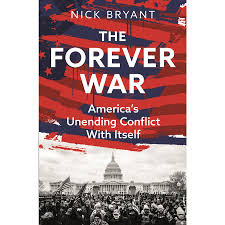
Review - The Forever War


Today, gentle reader, I'm reviewing Nick Bryant's The Forever War.

This is the second of Bryant's books I've read, and like the first one (When America Stopped being Great), it's an enlightening read.

It's also a little depressing, given the possibility that Trump may be "elected".

I put "elected" in quotes, because it is completely obvious, that even if you haven't followed US history, or read Bryant's book, the USA is not a democracy.

Stalwarts who admire America have always been honest about this. It's only non-Americans who seemed surprised when they come to the understanding that the country is a constitutional republic, not a democracy.

Bryant is in a good position to write about the USA. He's a Brit, who lived in the USA for years until his children went to school, and were obliged to participate in active shooter drills.

At that point he made the decision to move his family to Australia.

His thesis has two significant themes. The first describes the thread of violence that runs through American history. He describes violence as having been regarded as an acceptable means of managing power and politics across American history. 

The fact that four sitting presidents have been killed: Abraham Lincoln (1865, by John Wilkes Booth), James a Garfield (1881, by Charles J. Guiteau), William McKinley (1901, by Leon Czolgosz), and John F. Kennedy (1963, by Lee Harvey Oswald) makes that thread obvious.

Violence in the form of a civil war, the obscene regularity of mass shootings, and incidents such as the Oklahoma bombing and the Waco siege are cited by Bryant. This first element of his thesis is convincing.

Then he moves to an argument, which put simply, maintains that the Civil War has never ended. He traces the history of the pro-slavery Democrats, Lyndon Johnson's reforms, and what is known as REDMAP (Republican gerrymandering) that seeks to suppress African American voters. 

He maintains that race has been cynically used by both Republicans and Democrats as a tool to seek and hold power. He writes that despite the cliches surrounding the Kennedy brothers, that Lyndon Johnson (like Guy Fawkes perhaps) was honest about his intentions when it came to race, wheras the Kennedys weren't. Or put another way, the Kennedy's, especially Jack, used the issue to display their political morality, but Johnson did the hard yards in putting the reforms into practice.   

Given that both Kennedys were assassinated before their work was finished, it's difficult to make judgments about their sincerity.

As noted above, I find his narrative depressing, as he contends that the US constitution is largely incompetent, and written in a way that reflects the mores of the age. Those mores reflected a real fear of democracy, driven perhaps by the French Revolution.

He uses the events of January 6th 2021 to frame this narrative, and argues that Trump's coup went within a hair's breadth of succeeding.

In other words the American Republic is less a noble experiment than it is a reactionary exercise.

Time will tell, but unfortunately for Australians, the actions and fortunes of the USA influence life in this country. I learned that in 1970 in Vietnam.

It's beautifully written, carefully researched, and suffused with wit and irony.

It's a must-read.


Sunday, 23 January 2022

Blogging on Blogging


Pic courtesy timeshighereducation.com

I've been blogging, gentle reader, since October 2007.

Maybe it's time to review my experience with this strange method of communication, and to note some of the highs and lows, the costs and rewards, and the benefits.

Initially, I was blogging using a clunky Telstra platform, but any record of that that seems to have vanished without trace. We're told that the internet is forever, but I seem to have found the exception to the rule, as I haven't been able to dredge up any trace of the original blog.

The statistics are interesting. Years blogging amount to fourteen, unique page views are 253275, there are 1282 posts, and 3037 comments. I even made a small amount of money through the advertising, about enough to buy one cup of coffee each week. I avoided the temptation to advertise initially, but found (after a few embarrassing and inappropriate ads) that I could control the material. Then I became tired of eliminating the stupid ads, and removed the facility.

I have more readers in the USA than in Oz which is surprising (click to enlarge) -


There aren't regular followers, which is OK by me. There have been a few trolls down the years, but they seem to fade away after a while. That's a pity really, as they are an endless source of entertainment.

There were two persistent posters, one who took serious exception to my posting on another blog (Catallaxy) and attempted to attack my posts on that blog by commenting on this one. That kind of missed the point unless you were a regular subscriber to both blogs, but it kept him busy for a while.

The irony is that the original Catallaxy disappeared, so has been outlived by this one. The best summing up of the content of Catallaxy is this by John Quiggin - 

Catallaxy was an early example of the decline of libertarianism into what we can now call Trumpism.  By the end, the comments threads and quite a few of the posts were a toxic mix of racism, misogyny and conspiracy theories comparable to Sky After Dark or even Alex Jones.

There's a message in that somewhere. There have been attempts to resurrect Catallaxy, but now my posts there are censored. There's a lesson in that as well - something to do with free speech, I suppose.

I try to put something out there every week, but feel no obligation to do so. That is one of the benefits of this style of blogging. You post only when you are in the mood, or when you think you have something to say.

My memoir began as a blog, posted chapter by chapter. The responses to that original blog encouraged me to self-publish, and the original 1000 copies I had printed have almost sold out. There are only 180 copies left, and I recouped my printing costs in a month after publication. This blog is my one and only marketing strategy (apart from Facebook) and it works.

So I will continue to blog, gentle reader, as the mood finds me. It is great fun, and full of surprises.

Wednesday, 15 July 2020

Unforgiving


It's time for another book review.

This one looks at "Unforgiving" by Carmel Beresford, a self-published account of the life and tragic death of the author's son, and her struggle with the aftermath.

Not many books have left me with such a profound understanding of the human condition.

The reasons for that, apart from the depth of the tragedy described by the author, are the insights provided by her narrative. Carmel was the principal of a small bush school at the time of Sam's death, but it is apparent that she is also a talented writer.

She was also a very effective school principal, something I learned when I worked briefly a few years ago as a consultant in her school. Although I worked through many schools out west in my stint as a part-time visiting teacher, I remember her school much more clearly than others because of the remarkable community that she had developed around it.

The school reflected the values of the local community, and the needs and interests of the families whose children attended. The vege garden and the chooks were unusual, but reflected the reality of bush life, and the children took great care of them.

Sam was badly injured in an accident with a gyrocopter on 9th March 2011 and died eight days later. Carmel's narrative describes in confronting detail, his accident, the immediate aftermath, and her struggle with the trauma and grief that ensued.

The prose flows easily and honestly, and it is this flensing honesty that makes the book so powerful.

The author's love for her son shines through the pages, as does her love for the remote countryside in which it is set. Her strong family provides the human backdrop to the story, and her vivid descriptions of the physical landscape complement that.

Much of the book describes the author's attempts to get to the bottom of the tragedy, and her dawning understanding that her son was exposed to a very dangerous situation by the person who sold him the gyrocopter.

It concludes with a description of the legal consequences of Sam's death, and the author's arrival at the truth.

I strongly recommend this work as an account of a searingly honest journey through grief and trauma. The work itself is a fitting tribute to both Carmel Beresford's skill as a writer, and her undying love for her son.

Make sure you get hold of it.


Comments closed.

Sunday, 6 January 2019

Hastings’ Vietnam


I haven’t covered a book review for some time, gentle reader, so will fix that right now.

The book is Max Hasting’s masterful Vietnam, An Epic Tragedy, 1945 – 1975, a hefty read at 680 pages, but it took me about a week to complete. It is riveting.

It was a Christmas gift from one of my sons, who knows I’ve read just about everything published on the conflict, but successfully found something I hadn’t.

Most works on the war in Vietnam can be classified into one of three groupings – dry military histories, exploitative narratives, or political tomes. This book is none of these. It resembles a journey through events, incidents and personalities, and engages the reader through its use of vivid detail, unique perspective, and thoroughly researched context.

Hastings is aided by the fact that he is about the same age as I am, which means he lived through the events. I think this helps, as they were indeed exceptional times.

The author (an Englishman), has worked as a foreign correspondent for the BBC, editor-in-chief of The Daily Telegraph, and editor of the Evening Standard. He is also the author of numerous other works, chiefly on defence matters, which have won several major awards. He was knighted in 2002.

His approach is to present a series of narratives centred around specific episodes or incidents, starting with the siege of Dien Bien Phu in 1952 and ending with the fall of Saigon in 1975. His attention to detail is spectacular, and the contextualisation it provides brings the work to life. He has obviously researched the topic comprehensively, but the wonderful detail never slows the impact of the narrative.

If there is an underlying theme to this tragedy (and his summary of the title is apt) it is the contrast between the consistent cynicism of the great powers (the USA, the Soviets and the Chinese) and the consistent faith of the North Vietnamese Communists. The great powers never gave up using Vietnam as a plaything; the North Vietnamese never gave up seeking to unify the country under Communism. 

In the end, faith trumped cynicism - but at a terrible cost.

 The Americans saw the conduct of the war (once they had blundered into it) only in the setting of domestic politics, specifically the way in which it would affect Presidential elections. The Soviets and Chinese saw it as an opportunity to influence and manipulate the outcome of the cold war.
Neither the Americans nor the Communist bloc seemed to have any care or understanding of those directly involved – the combatants and the Vietnamese people. They were always collateral.

Hastings seems to divide the Vietnamese into two groups – those who supported the NVA, and those who simply wanted peace and survival. There was never, according to Hastings, a sufficient critical mass of Vietnamese in the south with anti-Communist sentiment strong enough to persevere. There were a few, but often they were sidelined by the Americans, a notable example being Ngo Din Diem, assassinated in 1963 with CIA approval partly because they were worried that he was showing signs of being beyond their control. The South Vietnamese had a dog in the fight, but the Americans wanted to keep it on the leash.  
The NVA, inspired initially by Ho Chi Minh, and after his death by Vo Nguyen Giap, probably one of the twentieth century’s greatest military strategists, never gave up. When asked how long the North was prepared to fight, Giap is quoted as saying -  ''Another twenty years, even a hundred years, as long as it takes to win, regardless of cost." He meant it.

This war was a war of images. You will recall the images of the naked Vietnamese girl fleeing a napalm strike, the footage of a Viet Cong being shot by a South Vietnamese commander during Tet in Saigon, and many images of the siege of Hue. In my experience, the best metaphor contained in an image is presented below, a Zippo lighter that could be bought for a few greenbacks at roadside stalls all over Phuoc Tuy when I was there in 1970.


These things sold well because the inscription tells a symbolic truth as experienced by the GIs and the diggers, and on another level by the Vietnamese people, except that the references to the “unnecessary” and the “ungrateful” have a deeper meaning. The great powers obviously believed that the conflict was necessary. The political leaders were certainly ungrateful in terms of their attitude to their returning soldiers.

The other little piece of symbolism refers to the Zippo lighter itself. Here was a saleable object that provided street vendors with an income. Many pragmatic Southerners used any opportunity to make a living from the war. First they had to survive; then they had to make a living.


The book has a great collection of images, and one illustrated above resonates with me. The shot is in the AWM collection, and depicts an incident involving my rifle section in March 1970. The digger being carried to a dustoff clearing is Gil Green, who had collapsed and become very ill after he reacted badly to camouflage cream we used. Strangely, the shortest man in the section (Bernie Cox - left) is paired with the tallest (Russ Hollings - right) at the front of the litter. I remember the desperation and confusion, and this physical mismatch depicts it clearly - a great shot. I think the bush hat to the left of Bernie Cox is mine, by the way, but the rest of me is hidden by Bernie's pack - probably a good thing. 

This juxtaposition of the suffering and privations of those directly involved in the conflict, and the cynicism of those directing it, is clear in Hasting's book. The same juxtaposition is a feature of Spielberg's The Post. The movie begins with footage of a VC ambush, and then switches immediately to Robert McNamara being interviewed after he had been briefed by a victim of the ambush. The reality of the war on the ground was well understood by McNamara, but he was unprepared to admit it. His eye was on the next presidential poll. Given the poetic licence used in the movie (it was actually the New York Times which first exposed the Watergate scandal), the point is valid.

Soldiers and civilians are collateral when politics is involved. Let's face it, the same applied in this country. Menzies commitment of Australian troops in Vietnam was political pragmatism. He needed to keep the DLP on side, to ensure their preferences. Fighting in a war against Communists, even if it was in peacetime on foreign soil, kept them on the leash.

It took until 1972 and cost 520 Australian casualties (200 of them conscripts) before it was over. Forty Vietnamese died for every American, and 4500 for every Australian. That is the real tragedy.

I can thoroughly recommend it, even if you're not, like me, a history tragic.

Wednesday, 10 January 2018

Fire and Fury

Pic courtesy Toofab

I've just finished this book, gentle reader.

You're not allowed to ask me how I got my hands on a copy.

Suffice to say, I have generous friends across the Pacific.

I will, however buy the thing when it hits the bookstores here - it's a riveting piece of work, and in many ways, horrifying. It is a must have in any library.

Even if it's only 10% accurate, what is described as Trump's conduct and the machinations of members of Trump's inner circle is at the same time bizarre, delusional and frightening.

Trump comes across as semi-literate, completely self absorbed, and with the attention span of a five year-old. In fact, much of his behaviour is toddler-like. It's all there - tantrums, a need for instant gratification, and more id than ego.

His family are milking his position for all that it is worth, and following disparate (mostly selfish) agendae of their own. The inner circle leaks like a sieve, because nobody trusts anybody - family included.

Mind you, when you look at his turnover of staffers and his incapacity to honour his election promises, the book sits very well with the facts of the history of his "accomplishments" so far.

He's managed to get one conservative judge appointed, but there is no Mexican wall, the Affordable Care Act has not been repealed, and the bulk of the rest of his promises, have stalled. He has granted his billionaire mates extensive tax cuts, but when you read the fine print, despite all the hype, they won't benefit middle class Yanks in any major fashion.

There have been a few grand gestures (Jerusalem), but even that has had largely negative consequences.

But for me, the issue is how somebody so demonstrably unfit for office can wield so much power.

Like a few of my generation, I felt the backhand of US policy in SE Asia, when our weak kneed government followed it back in the sixties and seventies. God help Australia, if a Trump tantrum involves us in something similar.

We can only hope that he is managed.

Incidentally, much of the energy consumed in the White house at the moment seems to be directed towards that - managing a loose cannon who responds mostly to self-absorbed whimsy, and takes everything personally.

He chews up staffers at an amazing rate.

Let's continue to hope that there are some strong and dedicated people able to keep him in check. the consequence of his escaping the long leash, are terrifying.

In the meantime, read the book. Make sure you have a strong drink handy......


Sunday, 2 October 2016

Ming Misremembered


Image courtesy Loonpond.blogspot.com.au


John Howard has been hosting an ABC production called Building modern Australia - Howard on Menzies.

It is hagiography rather than history. Howard mythologies Menzies to the point that you find yourself waiting for the suggestion that he (Menzies – not Howard) should be canonized. I suspect that the only obstacle in the way of that suggestion is the fact that Menzies was Presbyterian and Howard (nominally) Anglican.

Howard forgets that some of us (and here I am giving my age away – gentle reader) lived through the Menzies era, or some of it.

To believe that everything was rosy during Menzies’ period as PM ignores the historical statistics.

When I was a kid, there was a joke doing the rounds about Bob Menzies. My Dad, who was not renowned for telling jokes, repeated it in my presence on a number of occasions.

It went something like this –

Bob Menzies was surfing at Bondi one Sunday when he was caught in a rip. It was early in the morning and no lifesavers were on duty. Menzies would occasionally take early morning swims to avoid the crowds.

A teenager – a strong swimmer - saw that he was in trouble, and swam out to his aid, dragging him to the beach.

An exhausted and grateful Menzies said to the youth – “Lad, you’ve saved my life. I am the PM; I can give anything you want. What can I grant you?”

After a brief hesitation, the teenager said – “Can you organise me a state funeral?”

“Certainly”, said Menzies, “but that’s a strange request for one so young. Why do you want a state funeral?”

“Because”, said the young man, “If my dad hears I’ve saved Bob Menzies, he’d kill me.”
Ming in his day was not as universally loved as Howard mythologizes.

His failures were many.

He did, in fact, run budget deficits for the last nine years of his reign. When he left office, national debt was running at 41% of GDP. His deficits were proportionally greater than those chalked up by Swan. Remember the bitter criticism of deficit budgets thrown at the Labor treasurer by Abbott, Howard, Hockey and Co. Apparently that practice was OK in Menzies' day.
  
In 1950 he attempted to ban the Communist Party. The Communist Party Dissolution Bill was passed by parliament. After it was enacted in October, the law was challenged in the High Court and, on 9 March 1951, was held to be unconstitutional. The Court ruled that parliament could not invoke its defence powers to rule an association unlawful when the nation was not at war.

(Menzies seemed to believe that what was possible in wartime was also a goer in times of peace. This eccentricity in policy making reared its head again when he introduced conscription in peacetime – but more on that later)

He had another go in 1951 and sought approval this time for the federal government to ban the Communist Party of Australia by referendum. It was defeated. This approach has an eerie similarity to what we've been hearing from One Nation about Muslims recently.

But back to conscription. Menzies introduced conscription in peacetime on November 10, 1964; the necessary amendments to the Defence Act were made on April 6, 1965. This was despite the fact that it had never been a feature of Australian defence policy before, and referenda on the issue, introduced by Billy Hughes, had twice been defeated in World War One. 

It’s not difficult to understand why Menzies didn’t take this issue to a referendum. Despite the hysteria about “Reds under the bed” that he, and later the DLP had whipped up at the time, a majority of Australians didn’t want a bar of it. This had become abundantly clear by the time of the 1970 Moratorium marches.

The act of introducing conscription in peacetime did more to alienate a whole generation of Australians towards the Coalition that anything before or since. That gets small mention in the TV series. 

I guess it wouldn’t neatly fit the narrative.

The fact That Menzies dodged service in the First World War is also omitted.

It’s hardly a surprise to see Howard rewriting history to deify his predecessor. He behaved very much like Menzies. The best examples of this are his approach to the US alliance. Menzies gave secret undertakings to the US that Australia would be prepared to give legitimacy to a much increased US involvement in Vietnam through provision of Australian troops1. This was mimicked by Howard, nearly 40 years later in reference to Iraq.. 

The difference between Howard and Menzies was that the former wasn’t ruthless enough to send conscripts to fight in peacetime, or perhaps had learned from the history.

Howard, like Menzies, also whipped up fear to maintain power. In the case of Menzies, the target was Communism; in Howard’s case terrorism. 

There are some of us who have lived long enough to have seen it all before, and some of us that were part of that lost generation of conscripts...

1. WAR FOR THE ASKING: How Australia Invited Itself to Vietnam - Michael Sexton – New Holland - 2002

Sunday, 24 April 2016

The Anzac Myth

Photo courtesy the Saturday Paper


I came across this well written piece in The Saturday Paper.

It is especially relevant at this time, on the eve of ANZAC day, given the extensive and overblown mythology that has developed around what was always intended as a day of commemoration.

It also resonates with some research I did recently through the Australian War Memorial into a great uncle who served in France.

My great uncle's military records indicate that he jumped ship in Durban on the way to Plymouth, and was consequently separated from his unit. On arrival in the UK, he went straight into hospital with VD, no doubt picked up during the ten days he was AWOL in Durban.

His service records show that he embarked for France a few months later after a long stint in hospital, but the fact that he ended up with a different posting in a different unit from his original probably saved his life. More than half of his original unit were casualties, dead or maimed, in the nightmare that was the Western Front..

He survived and ended up marrying a French girl who had nursed him in hospital, strangely in the UK. I never did discover what she was doing in England.

They lived in France for a while after the war, but eventually found their way back to Australia in the twenties to settle in Clermont,central Queensland.

He died fairly young, possibly as a consequence of his service, but my French great aunt lived to a ripe old age. Stories of her eccentricities are part of our family history.

The article linked above discusses these issues at some length. It recounts the reality, not the myth.

Somehow the myth continues to grow, like a parasite on the truth, and it dishonours the memory of those who did not return.

On a personal note, I have been accused on a military blog of lying because I had the temerity to point out that the story going around that all Nashos who served in Vietnam were volunteers was rubbish. Somehow, the fact that National Servicemen were obliged to serve in Vietnam whether they wanted to or not, does not fit the narrative that we were enthusiastic about driving the Commies out of South Vietnam.

The National Service Act made it very clear that national servicemen on full-time duty were liable for ‘special overseas service’ including combat duties in Vietnam. This fact is conveniently ignored. The "all were volunteers" myth has been thoroughly debunked in mark Dapin's book - The Nasho's War, and before its release, research I'd done at the AWM was leading me to the same conclusion. There is no record of alleged "opt-out parades" anywhere in unit records or AWM documentation.

There may have been isolated incidents of unit commanders taking matters into their own hands and finding ways of weeding out unwilling conscripts, but I certainly was never given the opportunity. To enlarge this alleged practice to cover ALL Nashos is pure fiction.  

Dapin interviewed hundreds of Nashos and came to the same conclusion.  

The myth persists, and until a short time ago was included in material available to schools on the ANZAC day website. I emailed them with my evidence, but was ignored. My email remains unacknowledged.

Those who served were on the whole, ordinary men caught up in the absurdity of war. They wanted to live - they saw no glory in dying in war. They loved and were loved. They who were killed left family and lovers behind who will mourn them forever. 

Perhaps telling the truth about the ugly absurdity of modern warfare is too much for our delicate twenty-first century sensibilities, but is it OK to invent a false narrative to avoid such unpleasantness?

Update - As of 6th August 2018, and in response to further emails and a phone call, the ANZAC Day Commemoration Committee has amended their website and removed the reference to all Nashos being volunteers.


Friday, 20 November 2015

Kilcullen on ISIS


Since the Paris attacks, there's been an avalanche of comment on both social and mainstream media about the ISIS threat and how to deal with it.

Much of this comment is knee jerk, tribal, and a reflection of the depth of ignorance the Australian public has for both the history and the reality of this phenomenon.

If you're going to get into comment about current events, it's always useful to first identify individuals who have real experience of the issues in hand, knowledge gained through years of painstaking research, and the capacity to communicate this knowledge and experience clearly and succinctly.

Then you should probably read and consider their writings on the subject before making public comment..

David Kilcullen is such an individual.

His resume - (from Wikipaedia)
  
Kilcullen graduated from St Pius X College in 1984. He then attended the Australian Defence Force Academy and completed a Bachelor of Arts with Honours in Military Art and Science through the University of New South Wales and graduated as a Distinguished Graduate and was awarded the Chief of Defence Force Army Prize in 1989. He took his army officer training at the Royal Military College Duntroon. After twelve months of training in Indonesia, Kilcullen graduated from the Australian Defence Force School of Languages in 1993 with an Advanced Diploma in Applied Linguistics.  He is fluent in Indonesian and speaks some Arabic and French. 

Kilcullen received a PhD in politics from ADFA at UNSW in 2000. His thesis, entitled "The Political Consequences of Military Operations in Indonesia 1945-99: A Fieldwork Analysis of the Political Power-Diffusion Effects of Guerrilla Conflict," focused on the effects of guerrilla warfare on non-state political systems in traditional societies. 

His research centered on investigating power diffusion in Indonesia during the Darul Islam Era of 1948 to 1962 and the Indonesian occupation of East Timor f 1974 to 1999. Kilcullen argues that counter-insurgency operations, whether successful or not, cause the diffusion of political power from central to local leaders and that populations are the major actors in insurgency and counter-insurgency dynamics.

Kilcullen was commissioned as a Second Lieutenant in the Australian Army and served in a number of operational, strategic, command, and staff positions in the Royal Australian Infantry Corps and Australian Defence Force. He served in several counter-insurgency and peacekeeping operations in East Timor,  Bougainville, and the Middle East. Kilcullen attained the rank of Lieutenant Colonel in the Australian Army and served as a Staff Officer in ADF headquarters,. In 2004, he became a Senior Analyst in the Australian Office of National Assessment, where he served on the writing team for the Australian Government's 2004 Terrorism White Paper, "Transnational Terrorism: The Threat to Australia".

He left active duty in 2005 and is commissioned as a Lieutenant Colonel in the Australian Army Reserve.

 David Kilcullen was a senior advisor to General David Petraeus in 2007 and 2008, when he helped to design and monitor the Iraq War troop “surge”. He was then a special advisor for counterinsurgency to US Secretary of State Condoleezza Rice. From 2005 to 2006, he was Chief Strategist in the Office of the Coordinator for Counterterrorism at the US State Department. He has also been an adviser to the British government, the Australian government, NATO and the International Security Assistance Force. He is a former Australian Army officer and the author of three acclaimed books: The Accidental Guerrilla, Counterinsurgency and Out of the Mountains.

The following are extracts from his Quarterly Essay 58 -  Blood Year - Terrorism and the Islamic State.  

(You can purchase the E-book for $9.99. It's worth the read).

I've divided the extracts on the basis of theme. Kilcullen's text is in italics. Regular font is my summary.

Blame -

As I've explained, there's plenty of blame to go around. President Bush conflated enemies, defaulted to attacking states rather than thinking about how to deal with non-state actors, and - mother of all errors - invaded Iraq, and then botched the occupation.

President Obama compounded Bush's errors - pulling out without putting in enough effort to cement the gains of the surge, acting opportunistically in Libya, remaining passive in the face of massacre in Syria. (p230)

Responsibility -

After 2003 in Iraq, Western powers had a legal and ethical obligation to stabilise the society we'd disrupted, establish a successor government to the regime we'd overthrown, protect an innocent population we'd put massively at risk, and rebuild the economy and infrastructure we'd shattered. (p272)

Politicians acting tough -

..it's a criticism of decision-makers (usually, though not always, sitting in safety thousands of miles away, who've never heard a shot fired in anger) who succumb to the allure of Predator Porn, misusing these strategic assets - which should be applied sparingly as part of a broader plan - as tactical tools, to substitute for lack of strategic thought, or (worse) who send others in harm's way to make themselves look tough.
(p306)

What to do -

Militarily -

1. Ramp up the air strikes to a level resembling Kosovo and Libya. This may require forward observers on the ground.
2. Use the existing deployment differently. Get them out of the training bases and give them the authority to fight offensively.

Politically -

Hence a critical counterpart to the "war strategy" to neutralize ISIS in Iraq is a peace strategy in Syria - to end the slaughter by convincing all players that they can't achieve their goals through continued conflict, and that their best alternative is a negotiated peace. As in Bosnia, Kosovo and Libya, there may be a role here for the military, (specifically, air power): creating humanitarian corridors and no-fly zones, or inflicting sufficient damage on armed forces to force a ceasefire. But ultimately this is a political problem - and it will demand at least as much strategic effort and attention as the military problem in Iraq. (p328)

Conclusions -

1. We are living in an era of persistent conflict.
2. We need to remove ISIS as a state like entity using a larger more intense commitment, (though emphatically not an occupation or a counter insurgency campaign).
3. International engagement is a necessity. It's an international problem.
4. We need a strategy that recognises global terrorism for the threat it is, but doesn't treat it as if it's our only security issue. Between the overreaction of 2001-04 and the passivity of 2008 onwards, we need to find a middle ground.

He concludes -

Preserving and strengthening the political will of our societies, the will to continue this struggle without giving in to an horrific adversary, but also without surrounding our civil liberties or betraying our ethics, is not an adjunct to the strategy, it is the strategy. (p339)  

Pretty sobering reading, especially the reference to "an era of persistent conflict".

It takes me back to 2003, when, as Australian troops were being committed to the invasion of Iraq, I publicly refused to accept my National Service Medal from old mate Ian Macfarlane. This was my small protest against two things.

The first was being used as an ex-servicemen to justify a poor strategic decision. The second was the nature of the decision itself - a decision that emanated from Washington, not Canberra.

As Kilcullen has written - that decision was "the mother of all errors".


Euphenisms

Pic courtesy Shutterstock  The use of euphemisms has always fascinated me, gentle reader. One on-line dictionary defines the meaning of the ...