Friday, 5 October 2012

What bastard would park disabled?


To answer the title's question - plenty, some of them genuine, some self-appointed.

This pic, from Carsguide, is illustrative, and notable because the perpetrator was an MP.

But that's not the reason I posted it. Take a close look at the pic, and get an understanding of how you'd manage to get out of the car illustrated if you were obliged to use a wheelchair.

If you park correctly (leaving equal spaces each side) I doubt that you would have enough room to manoeuvre a standard wheelchair from the vehicle and away from the car park to wherever you were headed. The kerb would get in the way.

Generally, people I know who are wheelchair bound and drive use two door cars. They store the chair folded behind the drivers seat so they can push it out the door, unfold it, and transfer from the driver's seat to the chair. This requires a careful sequencing of tasks, and considerable residual upper body strength and mobility, something that not all people with spinal injuries have. It has been made especially difficult because of the design of modern vehicles, with a substantial dip between the rocker panel and the vehicle floor.

In fact, as cars have become lower and smaller, fewer and fewer people have mastered the technique, but for those who have, about a metre of space is needed to actually get out of the car independently. I doubt that it would be possible in the situation above.

The space is simply not wide enough. The bottom line is, not only do designated parking spaces have to be included, they also have to be wide enough. Many aren't.

So the problem is not only able-bods using the designated spaces, it's also that they're badly-designed to start with.

Years ago, I worked with a young female teacher who was paraplegic as a consequence of a vehicle roll-over. She was a top teacher, and a very determined individual. She had retained good upper body strength (partly as a result of playing competition wheelchair basketball) and used the technique described above to get around independently.

She owned a Holden Monaro two-door (this was back in the eighties) and it was perfect for the purpose with a wide door and plenty of accessible space behind the driver's seat for the chair.

One day she nipped out at lunch time to post an important letter. Again, this was in the eighties before email. The bell rang for classes after lunch, but there was no sign of her. This was unusual, as she was very reliable, and I had never seen her late for anything.

Eventually, a good three quarters of an hour after class started (I had incorporated her class into mine) she returned. To say she was stroppy was an understatement. Steam was coming out of her ears.

She's parked in a designated space at the local shopping centre, wheeled herself to the post box and posted the letter. When she got back to the car, she saw that someone in something posh (I think she told me it was a Jag) had parked so close to her car on the driver's side, she couldn't get near it.

She wheeled up and down the row of shops trying to find the owner, without luck. Eventually he returned. Apparently she gave him a mouthfull. I'm sorry I missed that - would have been entertaining.

Anyway, the moral of the story is - not only do able-bodied bastards sometimes use designated parking spaces, sometimes they park so close that people with disabilities can't access their cars.

Avoid both.  


Wednesday, 3 October 2012

Flying High


This is a fascinating piece of video of an interesting and unique aircraft.

The tail end of it shows the aircraft being piloted in by a guide driving a Pontiac (actually a left drive Commodore by another name and exported from Oz).

Landing is difficult - the wing must be stalled to get it down - not much room for error.

Hat tip to Plane Talking.

Monday, 1 October 2012

Alan Who?


Images courtesy of Andrew Bolt


The media is full of Alan Jones’ non-apology.

Why?

His "apology" if anything reveals him as a silly obsessed old man. Obsessed with himself - that is.  Why does any journalist give this shrill old Queen the time of day?

Perhaps they’re suffering from collective amnesia. They’ve forgotten that he was a strong supporter of Pauline Hanson. They’ve forgotten his adventures in London. They’ve forgotten that he made up stories reflecting badly on the ACT police when there weren’t as many trucks at his convoy of no confidence as he’d commanded.

They’ve forgotten his innumerable brushes with the courts. They’ve forgotten that he was largely responsible for the Cronulla riots. They’ve forgotten his unsuccessful venture into television.

They’ve forgotten his comments in 2000 called “outrageous and offensive” by the NSW Administrative Appeals Tribunal. It found that Jones had breached racial vilification provisions of the Anti-Discrimination Act when in April he made comments about an Equal Opportunity Tribunal award to an Aboriginal woman who had been discriminated against by a Dubbo real estate agent.

They’ve forgotten that he makes a living out of hate and vilification.

Perhaps they should close the loop and ignore him completely. This is standard treatment for an Id-obsessed child.

It would work with him, I’m sure.

Update - 

This graphic from First Dog is brilliant.


Update - This is timely.

Update - Even his own have dropped him.


Thursday, 27 September 2012

Respect


Whilst tidying up my study the other day, I came across notes of a staff development exercise I conducted at my school in the nineties in an attempt to improve cooperation and innovation.

They were great people, but most had been doing the same job for years (a common phenomenon in Toowoomba) and were a bit set in their ways.

Given the rate of change at the time, this had to change. How successful I was is difficult to judge in hindsight, but it was a useful exercise.

One of the tools we used was the Australian National Schools Network (ANSN) norms. These are essentially a set of principles to be used when working together to plan and solve problems.

It occurs to me that these same principles could be used in the blogosphere.

They are -

1. Adopt a sense of responsibility in and for the group
2. Attend to others and listen
3. Cooperate in good faith
4. Aim for consensus decision making
5. Confront problems respectfully
6. Allow and give no putdowns
7. Accept where others are at
8. Suspend judgements


Or perhaps in federal parliament?


Monday, 24 September 2012

My Beaut Ute


It’s been clear for some time now that I need a Ute.

The MX5 is a great little jigger, but when it comes to moving house, carrying cleared vegetation away, or disposing of years of accumulated household clutter, it’s not a lot of use.

This was brought home a few weeks ago when I drove to the local hardware store to get a few bits and pieces, and realised that most of said bits and pieces weren’t portable in the Mazda.

Offspring in shared student accommodation seem to move house at least annually, and I'm sick of hiring or borrowing Utes.

Having said that, anything I own has to be enjoyable to drive. I also prefer front engine, rear drive, and fully independent suspension. Once the decision was made to acquire a Ute, the next decision was which make.

Given my preferences above, it had to be a Commodore. I’ve owned Falcon sedans and driven Falcon Utes, and am familiar with the driving characteristics of the Henry*. They’re a great vehicle, but don’t drive as well as the Commodore.

The leaf spring rear end is also an anachronism these days. They’re OK when laden, but I’ll be driving the thing around empty most of the time.

The best value is had at auction, so that’s where I looked. I discovered a 2008 Omega with about 50000 on the clock, and ended up paying $3000 less for it than anything I’d found through a dealer or on private sale.

It’s ex Brisbane City Council, has been serviced regularly, and hasn’t copped a belting.

 The Mazda is sulking in the shed. It’s a lovely little thing, but life moves on.

I’ll make sure it goes to a good home.

*A Ford (as in Henry Ford).

Monday, 17 September 2012

Anger and Islam


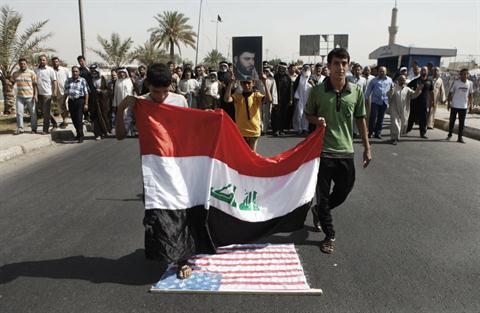
Demonstration against "The Innocence of Muslims" in Baghdad


Back in the 70s, to finish off one of my degrees, I studied Islam and its context and relationship to other monotheistic religions. Back then, it was regarded by those Australians who had heard of it (and there weren’t too many) as a quaint and harmless set of beliefs whose adherents prayed a lot but were generally pretty much like everyone else.

Since that time, I’ve had a fair bit to do with Muslims, including people who operated a chain of grocery stores and an obstetrician whom I got to know well when I lived up north. For a while I employed a Muslim woman at my special school. She was a compassionate individual for whom no task was impossible even with the most difficult and demanding children.

 My current GP is Muslim, although he’s lapsed a bit, much as I have with my Catholic faith.

My contact with these people has been generally very positive.

Recently I’ve noticed people in full chadri on the streets of Toowoomba, which I find simply incongruous. Something has changed in the last 20 years.

Rather than write it off as the rise of radical Islam, and to suggest that the solution is simply to take military action – essentially retaliation – I think a quick and dirty historical analysis might go some way towards understanding what is really happening.

On 11th September 2001, radicals who used the name of Allah as justification, killed over 3000 people in New York, Washington and Pennsylvania. Prior to this, there had been deadly attacks in Yemen (USS Cole) and the US embassies in Africa.

The USA attacked the Taliban in Afghanistan, and by dint of the use of technology and setting up proxies amongst the tribal groups there, cleaned them up quickly and comprehensively. So far so good, although the leader (Bin Laden) escaped.

Then it went pear-shaped. The Coalition of the Willing invaded Iraq on the pretext that the regime possessed weapons of mass destruction that were a threat to the west, and specifically to the state of Israel. The level of anger against the west escalated rapidly in Islamic communities across the world. There was a terrorist attack in Bali which killed many Australians.

A protracted struggle commenced in Iraq which killed (conservatively) over 110000 civilians. Literally millions fled the country, many of them Christians and members of minority groups. The coalition eventually extracted themselves but left a country destabilised and at risk of greater chaos in an already unstable region. Refugees from this conflict are a continual issue for many countries, including this one. Reports of bombing atrocities from Iraq continue to be routine.

As in other parts of the Middle East, there were demonstrations on the streets of Baghdad as a response to “The Innocence of Muslims”.

The question is – have we learned anything from this history?

To react with blanket condemnation of Muslims and to claim that they define themselves by their religion and won’t “assimilate” denies the course of history prior to 9/11 and the rise of radical Islam. As pointed out above there are generations of Australian born Muslims who weren’t really noticed as a minority group in years gone by. Let’s not conflate the thugs who kill and maim in the name of Islam with the vast majority who have contributed to our community and continue to do so.

History has shown that radical Islam feeds on violence. Military intervention resembles throwing petrol on a fire.

Remember the IRA? They too were violent thugs. They were also generally Catholics. Imagine the outrage if Catholics in Australia had been marginalised by association because of the bombing campaign in Belfast and elsewhere not that long ago. Nor did military intervention ultimately create peace in Northern Ireland.

That required patience, a political process and working towards reconciliation.

Whilst there is still tension in and around the six counties, the killing has effectively stopped. Maybe we should look at how peace was engineered in Northern Ireland before we advocate violence in the form of military action as a legitimate way of destroying radical Islam.

At the risk of sounding flippant, perhaps the fact that there were no reserves of sweet crude in Northern Ireland made peace-making there slightly more straightforward.

The first statement in the Downing Street Declaration which underpinned the peace process was –
The British government has no "selfish strategic or economic" interest in Northern Ireland.
 
I wonder if such a statement could ever be made by the USA in reference to the Middle East?

Saturday, 15 September 2012

A Cutting Analysis

Click on the scanned document for a better view


I've been able to obtain these figures which show cuts made to programmes by the LNP State government which have previously been supported, many of them for years.

I'd never argue that the government doesn't have to right to cease to fund these activities, but let's look at two issues. First let's examine what new initiatives have been funded, and then we'll identify the nature of those programmes which have been cut.

I'll do the second exercise first.

For the sake of brevity, let's classify them in the following way -

1. Targeting disadvantage - 5 programmes - $641000
2. Education - 19 programmes - $1729500
3. The Arts - 14 programmes - $1374400
4. Health - 3 programmes - $311000
5. Environment - 1 programme - $20000

The total savings are $4466000. It's important to understand that the withdrwal of these funds will effectivelly terminate many of these programmes,

In order of magnitude, it reads Education, The Arts, Targeting Disadvantage, Health and the Environment. This provides a pretty fair synopsis of the LNP's political ideology.

Now let's look at what has been enhanced or set up as a new initiative. This is much easier to identify. The cuts don't appear on the State Government website. The enhancements do. (Text in italics is from government press releases).

First, there's Racing -    This funding will be used to establish an additional 20 country race meetings per year, while another $5 million will be provided to the Queensland Thoroughbred Investment Scheme over the next two years, allowing Racing Queensland to increase much-needed prize money across the state.

Then there's the Commonwealth Games - The Newman Government has committed $20.9 million to the Gold Coast 2018 Commonwealth Games in the 2012-13 State Budget.

There's also a reshaped first home owner's  grant - Premier Campbell Newman said first home buyers would receive $15,000 - up from $7,000 - when purchasing a newly constructed home or property off the plan, under the re-shaped First Home Owner Construction Grant (formerly First Home Owner Grant).

This always goes down well with the Real Estate Community. They simply add the grant to home prices and pocket the extra commission.

There's tourism - $20 million Tourism Investment Strategy focusing on key emerging markets 
  
And police - $146.9 million over four years to deliver an additional 1,100 new police officers 

As well as Agricultural research - $4.8 million for research to develop Queensland as the food bowl of Asia with a focus on pulses 

So what else does this tell us.

It tells us that racing is higher on the priority list than targeting disadvantage. It shows that splashing money on the games rates higher than education funding.

It says that tourism rates higher than health (and the environment that presumably the tourists travel to see).

Appointing more coppers is simply a payoff to the Police Union, traditionally supporters of conservative government in Queensland. Remember Fitzgerald?

And it looks as if the vegetarians will be happy with the spending on research on pulses.

Compare the scale of it all -  a saving of $4 million to kill important (and in some cases vital) programmes as against spending of $178 million for racing, the games, tourism, real estate and coppers.

Some of the programmes lost include Federation of Parents and Friends Association of Catholic Schools, Q2 Smart and Healthy Programme, Queensland Museum, Queensland Program of Assistance to Survivors of Torture and Trauma and Vision Australia.

Funds for these programmes were all comparativelly small amounts compared to the iniatives on Racing - $5 million plus $1 million a year for the next 5 years, and $20.9 million on the games.

At least the blind kids in the bush will be able to go the rural race meetings. Whether they'll get the support they need with the demise of the Vision Australia funding is another matter entirely.


The Stranger's Case

The immigration issue is front and centre in the Australian media, both social and legacy, at the moment. There's an irony in the histor...