Saturday, 5 November 2011

Macdonald Mispeaks


Macdonald's been on the turps again.

It will be interesting to see if I get a response.

I won't be holding my breath.

Thursday, 3 November 2011

The Weird Book Trade


Writing was fun, but marketing is equally enjoyable. My book is selling steadily (1/4 of the 1000 copies print run so far).

This is better than break even point, so from here it’s all profit – not that I wrote it to make a quid.

It’s sold on consignment, although a few outlets are happy to buy say ten copies outright and give me the cheque straight up. One problem is shipping costs. Books are heavy. I’m currently looking at a quote from Toll-Ipec to get copies to centres like Adelaide and Sydney. I’ve sold plenty on-line.

The deal that works best is for me to send a consignment and to phone back in a month to see how they’re going. I’ve had to set up an invoicing system and a data base, tasks I hadn’t considered in my planning.

It’s necessary to maintain a momentum. People have to know the book’s out there. One way of doing this is radio gigs, and I’m doing one tomorrow on Radio National. This will make three so far (Local ABC and Radio101.5 FM Adelaide). There was discernible surge in sales after the last one.

Today I have a speaking gig here in Toowoomba. I’m never too sure what people want to hear. I’d be happy to say “Buy the bloody thing and read it”, but I doubt that would go down well. Apparently there are about 150 rolling up today, so it could be interesting. I’ll take a boxful and hope for some sales. Talk about singing for your supper….

I was surprised at the variability in the way the bookstores do business. The ABC shop requires that you go through their Sydney head office. Dymocks are happy to buy books if you walk in off the street and they like what they see, and Mary Ryan’s (a Queensland crew) have been great, even setting up a dedicated display in their local shop.

They also shout me free coffee, so I go there a bit.

 The book trade is in a sorry state at the moment with bookstores closing all over the place. Gen Ys and Millennials as a rule don’t buy books. They get most of their entertainment on-line and via hand held devices.

Maybe I should look at getting Jellybeans on an e-book. It’s a fairly straightforward process.

Sunday, 30 October 2011

Deja Vu

C-130E


So the Leprechaun’s spat the dummy and grounded Qantas.

This reminds me of the Australian pilot’s strike which began in August 1989.

This earlier dispute was about the Pilots and their wages. AFAP pilots decided to fly only between 9am and 5pm which effectively grounded the fleets of the airlines involved. Those affected were Ansett Australia East-West Airlines, Ipec and Australian Airlines.

Bob Hawke (PM at the time) brought in the RAAF, and they flew some routes to keep the traffic flowing. At the time, I was principal of a special school in Townsville, and was booked to fly to Brisbane for a conference.

On the day of the flight, I arrived at the airport with half a dozen other Townsville principals, after we were told the RAAF was doing the honours. Sitting on the tarmac like a beached whale was a RAAF C-130E.

It occurred to me at the time that I may have flown on this aircraft before, during training on the way to Shoalwater Bay and back, but then I remembered that in 1969, the aircraft were C-130As.

Nevertheless, I remembered enough about travelling on a Herc to prepare myself for a noisy and uncomfortable trip. I also remembered that it was not a good idea to choose a seat above the empennage for the undercarriage, as things got a bit cosy in that part of the fuselage where it narrowed to make space for the wheels. In this area it was necessary to interlock your knees with the person opposite because of the limited space.

I therefore gave up my place in the queue to move back just far enough to avoid this positioning, thoroughly confusing my colleagues, some of whom did likewise, and some who did not.

When we got to Brisbane members of the second group gave me an ear bashing because I didn’t warn them about the peculiarities of the C-130.

As to the current histrionics, the best understanding of what is really going on comes from Senator Nick Xenophon’s speech to the senate (under parliamentary privilege) on 23rd August 2011.

Some extracts –

Qantas has systematically built up the low-cost carrier at the expense of the parent company. I have been provided with a significant number of examples where costs which should have been billed back to Jetstar have in fact been paid for by Qantas. These are practices that I believe Qantas and Jetstar management need to explain. For example, when Jetstar took over the Cairns-Darwin-Singapore route, replacing Qantas flights, a deal was struck that required Qantas to provide Jetstar with $6 million a year in revenue. Why? Why would one part of the business give up a profitable route like that and then be asked to pay for the privilege? Then there are other subsidies when it comes to freight. On every sector Jetstar operates an A330, Qantas pays $6,200 to $6,400 for freight space regardless of actual uplift. When you do the calculations, this turns out to be a small fortune. Based on 82 departures a week, that is nearly half-a-million dollars a week or $25½ million a year.

And -
  
My question for Qantas management is simple: are these arrangements replicated right around Australia and why is Qantas paying Jetstar's bills? Why does Qantas lease five check-in counters at Sydney Terminal 2, only to let Jetstar use one for free? It has been reported to me that there are other areas where Jetstar's costs magically become Qantas's costs. For example, Jetstar does not have a treasury department and has only one person in government affairs. I am told Qantas's legal department also does free work for Jetstar.


(Hansard 23rd August 5259 19.37)

Given what Xenophon has revealed, there should be a judicial enquiry into the actions of Qantas management in flensing Qantas to stabilise Jetstar.

Saturday, 29 October 2011

Greed is the Creed


The science of the study of Anthropogenic Global Warming is often characterised as a religion by the vested interests that stand to lose if corporate behaviour is forced to change through recent legislation.

This characterisation of AGW as a cult is a worldwide phenomenon, but it has its epicentre across the Pacific, and is frequent fodder for the shock jocks.

The Yanks have a tendency to drop religion front and centre into any discussion about freedom and democracy. A road trip across the US is particularly revealing of the number and variety of religious organisations that infest the land of the free. Every second radio station is of the God-bothering kind. There is a strongly held belief that the path to heaven is via the cash register.

The most refined version of this thought, the most pervasive religion of all, and the one that presents the greatest danger to world peace, is also centred in the USA. That religion is Market Fundamentalism. It could also be described as Neo-Materialism or Corporate Greed and transcends borders, both national and international.

Its basic tenent is that the market should be left completely unfettered. According to this creed, this will allow for wealth creation and prosperity for all.

We saw where that got us a few years ago.

I would argue that the world government conspiracy, touted as a threat by those who despise the United Nations, is already with us, through the spread of transnational corporations that respect neither international boundaries, nor basic human rights.

The Occupy Wall Street protesters aren’t politically sophisticated or consistent with their demands, but a large part of what they’re unhappy about stems from the growing disparity between rich and poor worldwide, but particularly in the USA.

Maybe they have a point.

Consider, for a moment, the following –
The recession has hit middle-income and poor families hardest, widening the economic gap between the richest and poorest Americans as rippling job layoffs ravaged household budgets.
The wealthiest 10 percent of Americans — those making more than $138,000 each year — earned 11.4 times the roughly $12,000 made by those living near or below the poverty line in 2008, according to newly released census figures. That ratio was an increase from 11.2 in 2007 and the previous high of 11.22 in 2003.
Household income declined across all groups, but at sharper percentage levels for middle-income and poor Americans. Median income fell last year from $52,163 to $50,303, wiping out a decade's worth of gains to hit the lowest level since 1997.
Poverty jumped sharply to 13.2 percent, an 11-year high.

The clearest communication about this issue is best achieved graphically. Go to this series of graphics over at Business Insider to understand the dimensions of this problem.

 The “Find America” visual is pretty shocking to those of us conditioned by stories told at Grandad’s knee about the rewards for hard work and innovation available across the Pacific. The sad fact of the matter, is that using the Gini Coefficient, a well-recognised statistical measure of inequality, the USA is ranked at 96, indicating a greater rich-poor gap than stellar performers such as Turkmenistan, Mali and Uzbekistan, to name a few. Australia is ranked 24th by the way.

Strangest of all, two one-party states with “Communist” governments (Vietnam and China) are way ahead (62 and 83 respectively) and have much less of a poverty gap than the home of the free.


Tell me it isn’t so….

Friday, 28 October 2011

WITY?

       It usually means "what's it to ya". Only Blot knows what he meant.

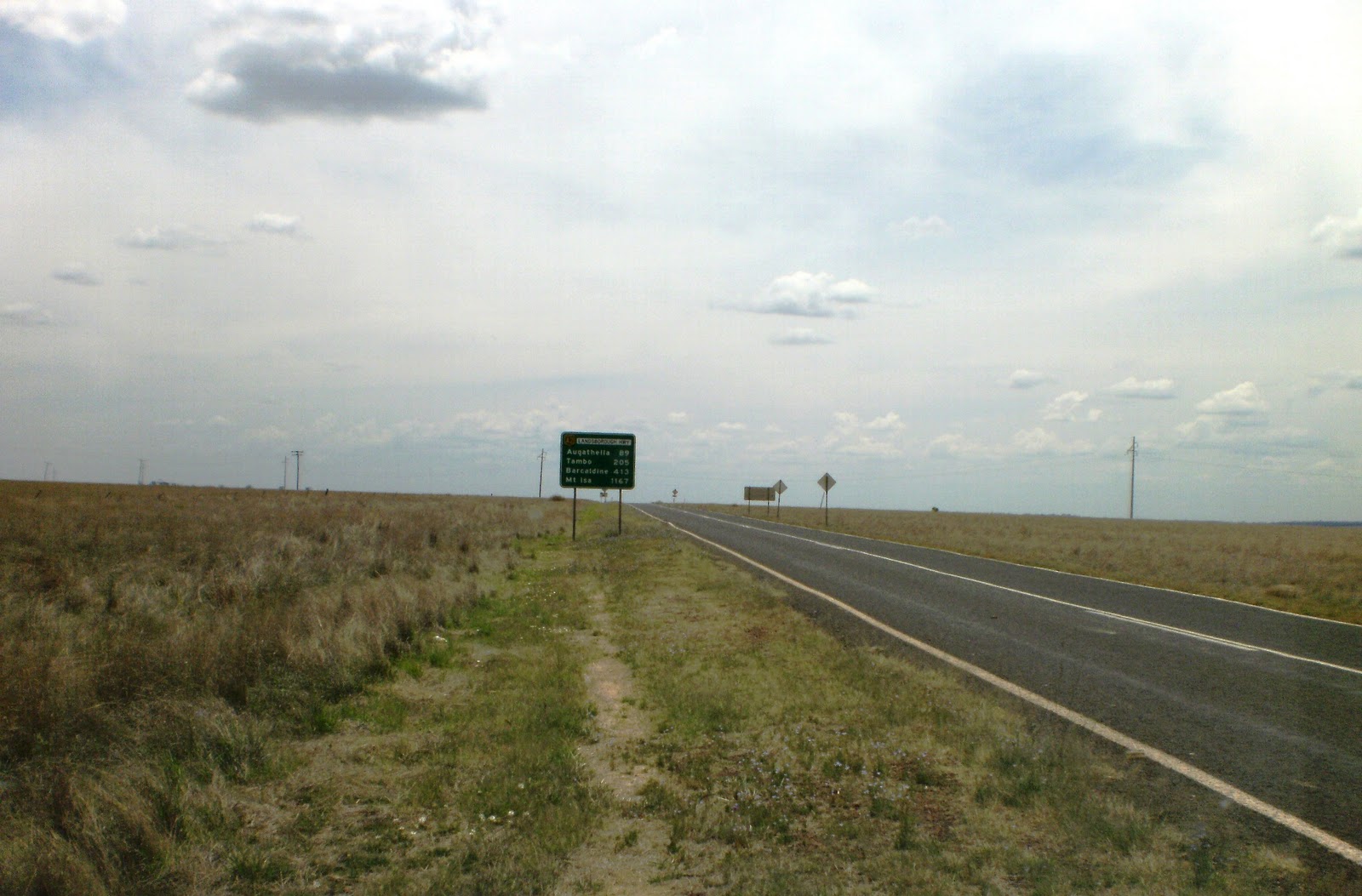
Out Tambo Way


This trip I was out Tambo way, at the extreme northern end of my area.

Looking at the map, you’d wonder why it is part of Roma district, but apparently the locals like it that way. It’s closer to Longreach than Roma.

Years ago, I was based at Mt Isa and came into this country from the North, rather than the South. I always feel at home in this part of the world, no matter which direction I enter it from. It’s more open than the country to the South, and strange as it sounds, it smells different.
Near Morven


You could blindfold me and take me out here, and if it’s early morning or late afternoon, I’d tell you where I was within 100kms of the location.

Big sky country


As the sun comes up and the land warms, the soil and vegetation release very characteristic smells that locate you immediately. In the evening, the land breeze gets up, and you get a different, but intense combination of perfumes.
Emus off to call home


It’s easy on the eye as well, although at the moment they’re having a hard time with fires. The best wet for decades has meant strong growth which has browned off. Dry storms, during which lightning starts fires, have done the rest.
Augathella ahead


There are a few emus about. I came across a couple in Morven intent on making a phone call. I have no idea who they were calling. You just never know with emus.  

I stayed in a local motel at Tambo, and wandered across the road for a meal. Their steaks were great, but the salad was a bit sad.

The school is a construction site with the last of the BER work underway. Out here, it takes a lot longer to get the builders organised. When it’s done, any kids out here who are in wheelchairs will be able access school without hassles. That’s a first for this part of the world.

By the time I’d arrived home, I’d travelled about 2000 kms, and was suffering a mild case of white line fever.
Sunset at Tambo


When I was young, I could drive these distances without needing a day or two to recover. Not any more.

Sunday, 23 October 2011

Putting it in Perspective

Couldn't find a pic of a digger


Given the continuing North Atlantic (US and Europe) financial crisis, this website puts one way of spending money in perspective.

Iraq has cost over the US $800 billion so far. It will be interesting to see what the final bill will be by the time they leave at the end of the year.

The war is "won" apparently, but Iraqis are still dying at the rate of over 200 per month. This is no longer reported in the MSM. It's not news.

It would be a fascinating exercise to post the same figures for Australia, and to break it down state by state and city by city.

By 2007, Iraq had already cost us more than $3 billion.

That was four years ago, and we've had Afghanistan since then. 

Signs of Hope?

  Pic courtesy The Guardian Last Tuesday's mid-term elections in that transpacific place give rise to hope. This is not only, gentle rea...