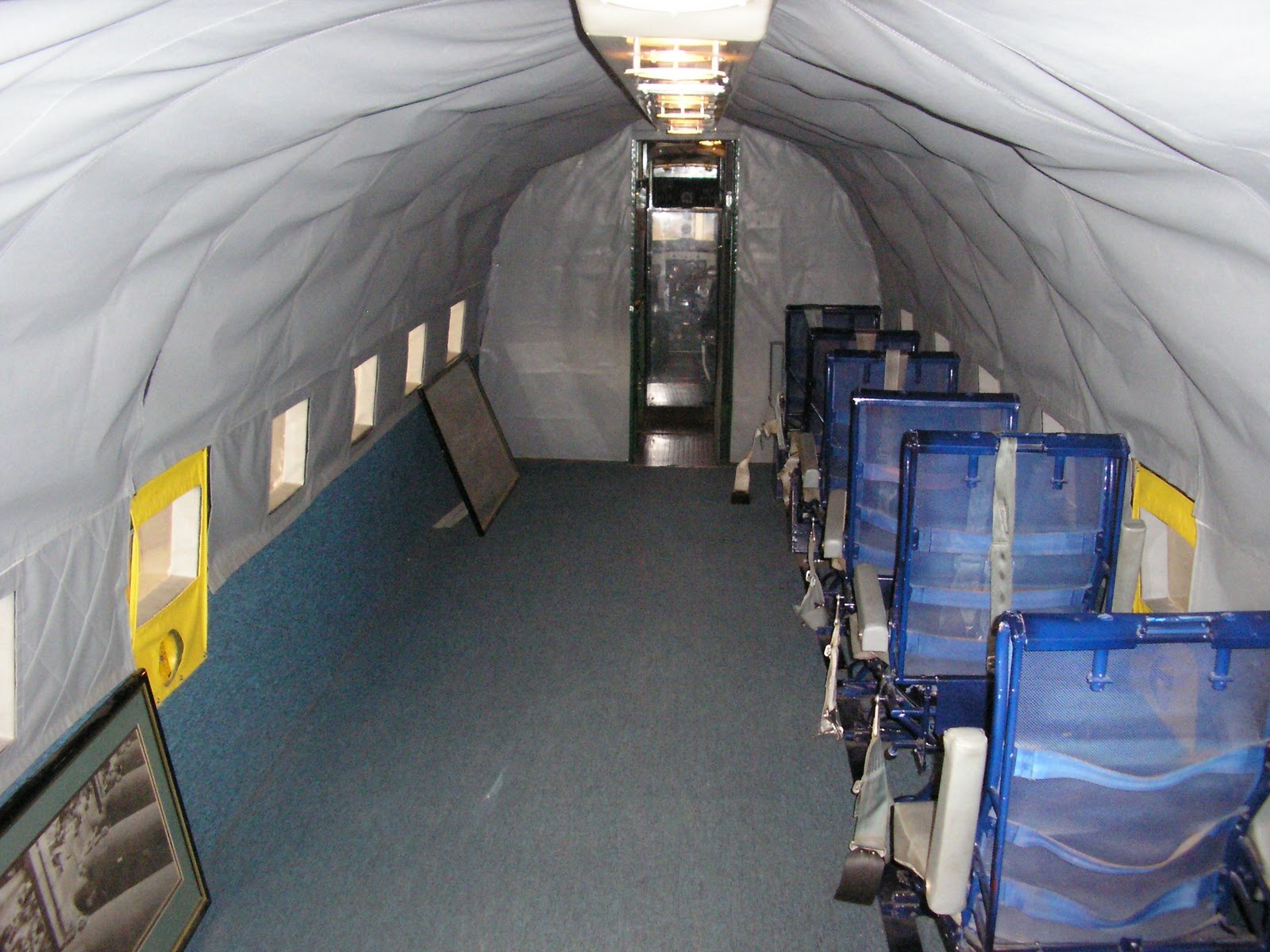
This is a small, but very well organised museum near the Old Port.
It is completely housed in one hangar, which isn't large, but both the quantity and quality of the exhibits make it well worth a visit.
The curators use a very basic technique to ensure that they pack as much as possible in the limited space. They simply remove the offending bits of the displayed aircraft.
In the case of the Aero Commander on display, they have amputated the tail. Larger aircraft have sections of wing removed. On the face of it, this sounds like vandalism, but it's done with care, airframe if it doesn't fit in the available space.This tecnique is confined to the airframes that allow visitor access. There are four aircraft that are accessible - an Aero Commander, an ex-CSIRO Fokker F-27, an ex-Navy Westland Wessex chopper, and an ARDC c-47. By raising the tail, the c-47 is arranged so that it's fuselage is level which makes for a more accurate display, given that the only time the tail was dragging was when the ship was on the tarmac.
The Wessex has a looping DVD that provides a history of the English Electric Canberra on operational service in Vietnam. Their role (out of Phan Rang) has largely been forgotten, but they were very effective and accurate. There is an account of the loss of an aircraft crewed by Bob Carter, who was a Toowoomba lad. His body and that of the other crewman were the last recovered in SVN. This incident happened in the last few months of my tour in 1970.
Seeing the F-27 brought back some sad recollections. My mother had invited three of my mates to my 13th birthday party in North Eton (near Mackay) where we lived at the time. The party was to be held the day after these kids flew home from Rockhampton (where they were at boarding school). They were lost when VH-TFB (Abel Tasman) hit the sea off Mackay at night in fog. This disaster made a profound impression on me at the time. The cause of the crash was never determined - it was in the days before black boxes.
Weatherwise, it's a place of vivid contrasts. In the six visits I've made over the years, I've experienced most of them.
I remember a Sunday in March a few years ago being confronted by a 42 degree blast as we left the airport. It felt very much like Mt Isa. The place was slowly cooking.
This trip the city is sulking. The sun lurks rather than shines, and there always seems to be a sneaky cold breeze.
Back in 2002 I came to a Principal's conference here. It must have been about this time of the year, but it was hot then - totally different from now.
Speaking of contrasts - I can't help but compare Adelaide to Brisbane. Up north, there's a wider variety of vegetation and building styles. The first is a consequence of geography,the second of building codes and covenants. There's a lack of discipline and a sense of haphazardness in Brisbane. In Adelaide, it's all steel, masonry and angles, and there is a pleasing (sometimes boring) consistency in the building styles. The lack of timber surprises if you've been brought up in the tropics.
People here drive with a strong sense of self-absorption, reflected in their tendency to pull into a fast-moving stream of traffic without a backward glance. You can also (if you're mad enough) park in the clearways at certain times of the day. This has some interesting effects if you drive in the outside lane.
Still, it has a charm all of its own. People are generally laid back.They smile readily, and seem prepared to engage. They wear lots of black - perhaps climate related, but unlike the Melbourne black it's less about appearing cool, and more about "what the heck - I can't be bothered thinking about clothes". There are festivals and trams, and some great tucker.The coffee's not bad either, even if it's best used to keep your hands warm.
I've been privileged to travel west during the best season for decades.
This is particularly evident in the country around Quilpie and Thargomindah. Water is everywhere. It brings out birdlife, snakes, and every creature that has been lying doggo for the last ten years or more.
This is rich country when the season is good, and it's easy to see how many early settlements were made which didn't in the long run, stand the test of time. Settlers looked at the country in a good year, and assumed it always looked like this.
Used as they were to reliable seasons in the old country, they simply couldn't get their heads around the notion that good rains came every ten years or so, rather than annually.
Right now, it's a treat and a rare privilege to see it.
The grins are nearly as wide as the waterlogged country.
My last trip this term was to Cunnamulla. Cunnamulla is always interesting. It was particularly so this trip because of my erratic short-term memory.
I cart a bit of gear around the countryside - laptop, memory stick,mobile phone, files etc. Because of previous bad experiences (leaving a memory stick at Thargomindah, for example) I have developed a few strategies.
One that has worked well is to write a check list (aide memoire) on the back of the ID pic that I wear around my neck on a lanyard. The theory is that I always check this list as I get back into the vehicle after I leave a school, office or my accommodation.
Because I flew out this trip, I didn't have a vehicle, and had to leg it from one school to the other (there are two I work in at Cunnamulla). The "getting in the vehicle" cue was therefore absent, and when I arrived at the second school I realised I'd left my lanyard (with both the memory stick and the checklist attached) behind. There is a bizarre irony in that somewhere.....
This meant that I had to walk back to school one to collect it, and then walk to school two all over again.
The parish priest (the second school was the Catholic school) offered me his push bike* but I declined for two good reasons.
The first was that I would have run the risk of breaking both my neck and his bike in one go, and also that in Cunnamulla, everyone knows the parish priest, and I'd put odds on being the victim of a citizen's arrest on suspicion of nicking his bike.
It ended well,in terms of the work done, and I got plenty of exercise. The memory problem has, by the way, nothing to do with advancing years - I've been leaving stuff behind for decades.
The pic is the aircraft. I tried to upload a video - but my poor little EEPC didn't have the grunt. I'm travelling (Adelaide - Perth etc) so will have to put up with it.
The lady in this case is The Australian. The Fart of the Nation has come out all defensive. This is a reaction, apparently, to being called for bias in recent reporting about the Greens. It's nothing new, of course. The Australian has to be the most openly biased newspaper in the country. I don't have a problem with bias; it's the prerogative of the editor. I do have an issue, however with hypocrisy, and the paper's reaction is both hysterical and hypocritical. The Australian's habit of grinding away at the same issue ad nauseam after a time resembles the print equivalent of a bunch of soccer fans blowing vuvuzelas. The result is weariness and boredom on the part of the reader and loss of valuable column space which could be used to convey something representing news. It is called a newspaper, I understand. People blowing vuvuzelas have the excuse of spontaneity. There is nothing spontaneous about the Oz's editorialising - it's orchestrated to the nth degree. But even in their day to day compilation of news and opinion, the bias is still there. It's more haphazard, of course, when compared with the orchestrated anti-Labor bias of the last campaign, but it's starkly obvious. Take today's home page, for example. I counted 20 story headings. Anti-government (or anti-Labor) sentiment is expressed in every story, with the exception of the football piece and Lomborg's article. It's almost as if this is a requirement of publication Stutchbury - Despite the heading about Abbott's populism, he's having a go at the government. Hendrickx - Looks like a dig at the ABC, for sloppy reporting, but the flavour is denial. Savva - Again, looks superficially like she's having a go at Abbott, but the content smears the ALP. Rodan - An extract - "one could be forgiven for concluding that government views international education as a liability" Callick - An extract - "Not that Canberra appears to have noticed" when describing trends in trade. Shanahan - It's difficult to show bias in reporting a poll, but he goes close. Smith - Irrelevant - It's about aerial ping-pong after all. The cut and paste is a very good example of variations on a theme. The theme is criticism of anyone who dares to disagree with the Oz's editorial position, and an attempt to smear the ABC. Lomborg - The exception that proves the rule. The only piece on this page worth a read. Guess what - it contains no smears. There's a connection there somewhere. Hewett - Synopsis - The government is responsible for Telstra's shares going South. I could go on. I won't. The pattern is clear. The bias in the Oz is built-in. It's embedded as a requirement placed on contributors by editorial policy. It's remarkably clear and consistent
One of the problems associated with living in a relatively small city is that there are a limited number of places in which to remain anonymous.
Anonymity matters to me inasmuch as I have a family who may suffer from my strong on-line opinions. It's not fair that they should be effected by this, hence my tag and my efforts to remain in the shadows. I have, under my tag, been threatened with all sorts of things, principally by the nutjobs on A Western Heart. Don't go there.
Anyhow, I went out this morning to transact some minor business at my bank which is located in one of the large shopping centres. It was obviously the morning when the kids from the local special school were doing their Skills for Living training.
This involves being given a shopping list and a defined amount of money, and assigned to the task of purchasing these items. It's a good programme, designed to equip them for independent living when they leave school.
Their supervisors (Teachers and Teacher Aides) hover about, trying to remain as much as possible in the background, at the same time making sure they're safe and out of trouble. Some of these kids have severe autism, so supervision is necessary.
This is all OK, except that these are all kids who were attending my school five years ago when I "retired" and they all remember me. Unfortunately for me, I don't remember their names as well as they remember mine. So I get claimed loudly every time, and then have to stammer my way through a conversation without using their names. Sometimes, they're wearing backpacks with names on and that helps. They usually great me loudly, with great enthusiasm, and everyone within ten metres is well and truly aware of the situation.
Anyway, they're great kids, and I guess I should be pleased that they remember me well. It's just a bit embarrassing.
Now that the decisions are made, and those that aren't happy are directing streams of abuse at Oakshott and Windsor, it's timely to look at what Bob Katter was knocked back on in terms of his demands for support for voting for the government.
This list has been overshadowed by the white noise created by the outcome, albeit delayed, of the election.
It's worth noting that this isn't the first time we've had a government that doesn't enjoy majority voter support. The hue and cry about this indicates many of the commentators responsible have forgotten (if they ever knew) how our parliamentary system works.
Anyway, here's Bob's list -
1. Creation of a National Energy Grid facilitating resource development, the decentralisation of population and clean energy resources.
2. The removal of the tax on Australian-produced bio-fuels and the introduction of a statutory 10 per cent bio-fuel (ethanol) content in all petrol rising to 22 per cent (as in Brazil).
3. Address the two chain oligopoly in the Australian food retailing sector. The option of divestment (a maximum market share for any chain of 22.5 per cent only) and/or a maximum mark-up of 100 per cent between the farm gate/factory price and the retail price.
4. No carbon tax. No emissions trading scheme.
5. No mining tax.
6. Return of recreational freedoms to traditional pursuits of fishing, camping and outdoor sports and activities. This includes the removal of the Wild Rivers Legislation.
7. Provision of title deeds providing ownership of homes, businesses and farms … to indigenous communities.
8. Legislation to ensure that the constitutional right to full compensation for the taking of property by government be extended also to the taking of any property “rights” by government [such as land-clearing by farmers].
9. Commitment to the use of some part of the Future Fund for the creation of a national development corporation for major infrastructure and strategically important industries.
10. Restoration of collective bargaining rights to Australian farmers. Where a majority of farmers in an industry request collective bargaining arrangements, they be provided.
11. Rural and country hospitals and dental services will be placed under the control of a restored local hospital board and that funding be delivered from Canberra directly to these hospital boards.
12. Agreement that where a food or plant import licence has not been approved, approval can only be granted when the country of origin can establish that is has no endemic diseases that can be imported into Australia.
13. The utilisation of 3 per cent of northern Australia's abundance of water to enable irrigation for small areas of agricultural land sufficient to guarantee a healthy growth in Australia's agricultural sector and to provide food security for our people.
14. Establish a taskforce to secure action to provide: all-weather anchorage roughly every 30 km; … micro resource development at five towns in the QueenslandGulf and Mid-West; … a port to service the southern Gulf of Carpentaria; upgrading the McEwen highway.
15. Government-provided solar hot water systems and/or other measures to reduce the money problems on our older generation caused by rapidly escalating costs for rates, electricity, insurances, car registration and other similar charges, which, increasingly, they are unable to meet.
16. Equal rates of government-funded parental assistance for working mothers and stay-at-home mums as well.
17. An agreement that the Commonwealth meet with the Queensland Government and secure relaxation of restrictions on land sub-division and boundary realignment prohibitions.
18. Address the unfair and artificially high value of the Australian dollar, on which upward pressure is placed by interest rates that are out of step with international benchmarks.
19. Introduce an open, public registry of foreign ownership of farm land, housing, public and private corporations and re-examine the thresholds on foreign ownership requiring FIRB approval.
20. A review of zone allowances for remote areas. Tax should be levied on “real" purchasing power, not monetary purchasing power, as $100 buys a lot less goods and services in Cloncurry than it does in Brisbane.
After forty years of working in the bush, I can see where he's coming from.
The first three points would benefit many, and disadvantage only the vested interests involved in the retail and oil monopolies. This is, of course, why they won't ever be implemented - the big end of town has too much influence on both sides of politics.
Points 4 and 5 obviously weren't acceptable to Labor. It's worth noting that Katter makes reference to global warming in points 1 and 2 and 15 which indicate that he is not a denier. There is a logical inconsistency here. I wonder if a bit more negotiation may have changed this. We'll never know. The mining tax issue is the one exception to Katter's preparedness to take on the big end of town.
Points 6, 7 and 8 are very clear reflections of need in his electorate. Point 9 makes a lot of sense to me, and I'm sure to many rural and regional Australians. Point 10 has its origin in Katter's Labor roots in its use of language. The point (11) about rural hospitals again reflects what he's seen in his electorate. My understanding is that Mt Isa is the only place in Kennedy where a mother can give birth. This situation is not unique to Kennedy, of course, but given the size of the electorate it is a major issue for families, and indicative of the running down of basic health services in the west.
Point 12 sounds like common sense, but again there are enormous vested interests ranged against it. Points 13 and 14 are Bob's very own initiatives, again driven by what he hears from his constituents. Point 15 again sounds like common sense, and would not be fiendishly expensive. Point 16 needs more detail but sounds like a great initiative. 17 and 18 are both issues that Bob has been on about for years, and are again driven by his rural constituency. His chances of getting anywhere with the dollar issue are nil given the influence of the big end of town.
Point 19 is long overdue, but again there is too much international financial muscle ranged against it. These people don't recognise national boundaries.
It's about time the taxation system was harnessed to provide equity for individuals and corporations in the bush. Given the services lacking in many remote and rural areas many of these people shouldn't be paying tax at all.
Good on you Bob. Keep pushing these points. You still have the power to influence.
And a brief message to the pollies and pundits who are screaming about the result. You have short memories.
John Howard had no compunction about taking power from Kim Beazley in 1998 when he received fewer votes on a two-party preferred basis.