Showing posts with label USA. Show all posts

Sunday, 5 July 2026

The Fourth of July

The pool is stained. (Pic courtesy the Guardian)
 

Yesterday was the fourth of July, gentle reader, so we're bombarded via the media with stories about the 250th Anniversary of the adoption of the USA's declaration of Independence.

It can also be called a semiquincentennial, if you're keen to impress with your vocabulary.

To be frank, the celebrations leave me more than a little unimpressed, as they're characterised by vulgar expressions of American exceptionalism.

In fact, down through the years, much of what happens on the other side of the Pacific has left me unimpressed, but unfortunately it can't be ignored. Decisions made in Washington, and the vicissitudes of American culture and history have affected my life and experience.

I remember being shaken awake by my father on 22nd November 1963 to tell me of John Kennedy's assassination. He was succeeded by Lyndon Johnson, whose cynical use of the Gulf of Tonkin incident on 4th August 1964 to gain congressional approval to wage war in Vietnam had a major influence on my future.

Australia's commitment to send troops to Vietnam in April1965 was largely triggered by American policy, and it was only one month later that our defence act was amended to allow conscripts to be deployed overseas.

Then in 1967 my birthdate was drawn in the national service ballot, and after deferment for eighteen months whilst I graduated as a teacher and worked for twelve months to discharge my bond, I was enlisted in January 1969.

Vietnam followed in 1970, and it was then that I had my first encounter with American GIs. They also left me unimpressed. They were very poor soldiers, and our unit gave them a wide berth, as they attracted unwanted attention from the VC.

There were also two occasions when they went very close to causing us real harm. The first was when we encountered a bunker system in April, and USAF F105s dropped napalm closer to our position than the bunkers. The second was a few months later when an American artillery detachment based at the Horsehoe lobbed a couple of salvoes of 155mm rounds on a track junction we were ambushing because they neglected to check for friendlies prior to the fire mission

We discovered that the reason for their carelessness was their practice of using marijuana during fire missions to escape their apparent boredom.

We had a couple of phrases describing the Yanks. The first was "They draw the crabs" and the second "You can tell them anything; sell them anything".

The second aphorism helps to explain the "election" of Donald Trump. I put "election" in quotes, because you look at the turnout figures in the 2024 presidential election, and examine his slim majority, you understand that he was supported by about one third of American voters. Trump's 77.2 million votes  equate to roughly one-third of all eligible American adults. 

When the financial crisis arrived in 2008, like many other Australians I lost a large chunk of my superannuation balance because of regularity failure across the Pacific, and most recently, American foreign policy pushed fuel prices higher and contributed to inflation in Australia.

Today I read a post by an American on social media telling Australians how grateful we should be because they saved us from the Japanese in World War Two. 

This same American is no doubt ignorant of a number of salient facts of history. The first is that the US didn't enter hostilities until two years after the rest of the free world, and only then after their Pacific feet was blown out of the water on December 7th 1941.

The second is that Australian troops were the first to stop the Japanese on land in New Guinea.

And the third was that they supported us out of pure self interest. Australia was, after all, an unsinkable aircraft carrier.

You'll just have to forgive me for remaining unimpressed with the USA after the impacts it has had on my life since 1970. They continue to tell us how wonderfull their republican experiment is.

Frankly, it's still very much a work in progress.


Saturday, 20 June 2026

Trump in Drag


Pic courtesy The Australian

Last Wednesday we saw Pauline Hanson front the Press Club.

She was given a free pass to talk for almost twice as long as most speakers, and we were exposed to all the ugliness of her grievance politics.

She abused journalists, trotted out a range of the same cliches that she's been whining about for over thirty years, and continues to be unable to pronounce the name of our country. That ought to tell you something.

But to me, the most alarming feature of her address was its resemblance to the style and delivery of Donald Trump.

First of all, like Trump, her style is incoherent and aggressive. Her delivery was peppered with half-truths, insinuations, and condemnations.

It was an appeal to the darker sides of our national characteristics, those of xenophobia, arrogance and paranoia. The Australian values of tolerance, a fair go, and generosity didn't get a guernsey.

And her speech was replete with figures which, when subject to analysis, are largely confected.

She said - 

Again, the 2021 census showed that 1 in 4 people, 23% speak a language other than English at home, the most common being, Mandarin and Arabic.

Then -

How can you generate social cohesion if people can’t speak the language? In that same census, 872,000 people self-reported, as speaking English “not well” or “not at all.”

When this is examined, there is a clear inference that 23% of people who speak a language other than English at home are a problem. She tries to conflate bilingual Australians with non-English speaking Australians. Whilst she doesn't explicitly state it, her followers will conflate the two sets of statistics. It's not what she said that's the problem, it's what her followers heard. That's classic dog-whistling.

Then there was this -

Forty-three per cent of low-income renters were experiencing rental stress. Up to 3.2 million people in Australia were at risk of losing their home, and we know that around 130,000 Australians are sleeping rough every night.

She provided no definition of "low-income renters", nor did she reference her figures. Then she said - 

According to official data from the Australian Bureau of Statistics  7,600 people sleep rough on any given night across Australia. 

This figure represents roughly 6.2% of the total homeless population, which exceeds 122,000 individuals. It looks as if she's done some more dodgy conflation, inferring that all people classified as "homeless" always sleep rough. Again, she talks about two separate sets of statistics, and uses the breakdown of one set, then applies them to both. She doesn't do this explicitly, but the inference is enough for many of her followers who can't see past the confected outrage, to wrap them up together. 

Again, her statistics are dodgy, as is the notion that there is a direct connection between the homeless crisis and immigration. It simply doesn't add up. She confuses common sense with ignorant assumption, and encourages her followers to do the same.

She talks about the Salvation Army's Red Shield report, and lists a series of figures from the respondents to that survey. Again, she neglects to mention who those respondents were. The survey pool was a total 4400 respondents across the country. The respondents were vulnerable community members who had accessed the charity's Emergency Relief services (such as Doorways services) within the prior 12 months. So again, she's referencing 4400 people from a population of 28 million.

She then goes on the quote percentages from this group of 4400 people, and pretends to apply it to the total population. Again, she doesn't explicitly do this, but leaves it to her supporters to join the dots, even though what they will come up has only a casual relationship with the truth. This is textbook Trump.

 Food insecurity is unacceptable in a country like Australia, but with a population of 28 million, it's nowhere near the crisis that her dodgy statistics imply. Most of what she says is skillfully designed to generate outrage, and outrage plays well with semi-literates on social media. It feeds the algorithms, puts money in the pockets of big tech, and contributed in no small measure to the popularity of Trump. 

Trump's relationship with Musk puts the social media-populist politician relationship in stark relief. Hanson's relationship with Rinehart is a horse of a similar colour. Many billionaires are quick to chum up with politicians that can get into a position of power, and legislate to enhance their portfolios. Besides, Rinehart's father was renowned for his answer to what he called the Aboriginal problem, He advocated that indigenous Australians should be bred out by doping their water supply to make them sterile.

Much of what I see in Hanson resonates with my lived experience in the sixties and seventies. The injection of fear into our political culture at that time had me sent to a futile war as a conscript. The fear was communism, used by a lazy Coalition government. The political manipulation of that fear went close to costing me my life, and it killed a couple of my mates. 

Hanson sells fear of Muslims, Asians, and Aborigines. Selling fear to gain power is often catastrophic. A quick scan of twentieth century history reveals this solid truth. 

Australian voters woke up by 1972, but much harm had been done by then. Let's hope they wake up to Hanson a bit sooner.

She resembles, after all, Donald Trump in drag.

Friday, 24 April 2026

A Just War or Just a War?

Pic courtesy Leunig and Jason Goroncy

 No doubt, gentle reader, you have come across the criticism of Pope Leo by the POTUS.

On the face of it, none of Trump's Truth Social post  makes a great deal of political sense. He needs the conservative Catholic vote in states like Pennsylvania, michigan and Wisconsin, which were fundamental to his election in 2024.

What is also hard to fathom is his grounds for this criticism. His Truth Social post talks about Leo being "weak on crime, weak on nuclear weapons", and mentions a meeting with David Axelrod. 

Now Leo has not made any definitive statement about crime since he began his reign as pontiff,  apart from criticising state crime in Iran after the reported killing of protestors. Maybe Trump doesn't believe there is any such thing as state crime..

As for nuclear weapons, Leo has described nuclear weapons as "a profound horror" and "an affront to humanity".

So maybe Trump is unhappy about the Pope's criticism of the war against Iran.

That criticism did not name either Trump or the USA, but did call for deescalation. 

In any event, the Pope is qualified (unlike J D Vance) to talk about the moral theology underpinning the notion of a just war. For a war to be just, a number of criteria have to be met. Frank Brennan discusses this in his homily given on the Third Sunday of Easter.

He quotes Cardinal McElroy of Washington, who pointed out that the war was not necessary, that diplomacy had been bulldozed, and that there was ambiguity about the intention and purpose of the military commitment.

The principles of a just war are that it has just cause, is a last resort, is declared by a proper authority, has a right intention, and a reasonable chance of success, and that the end is proportional to the means being used.

Trump's "just cause" has ricocheted between preventing Iran accessing nuclear weapons and changing the regime. Strangely enough, there was an agreement called the Joint Comprehensive Plan of Action (JCPOA) supervised by the International Atomic Energy Agency, limiting Iran to nuclear material insufficient to construct a bomb, but that agreement was dissolved in May 2018.

Guess who withdrew from the agreement. I'll let you guess. It wasn't Iran.

Trump appealed to the Iranian people to overthrow the mad Mullahs, but was unwilling to provide any material support, so any sane observer might be tempted to doubt that genuine regime change is part of a just cause.

As for "proper authority", Trump doesn't have congressional approval, and the "reasonable chance of success"  seems to have evaporated with Iran's persistent intransigence.

The USA's attack on Iran in the middle of diplomatic negotiations reminds me eerily of Japan's attack on Pearl Harbour on 7th December 1941.

Was Imperial Japan's aggression part of a "just war" back then? The lead up and sequence events are similar. There's a fair chance that the outcome for the aggressor this time will also be similar.

Thursday, 9 April 2026

The Mug Lair

Pic courtesy South China Morning Post

I've blogged before, gentle reader, about the relevance of language, and observed how it has changed and developed during my lifetime.

According to the Dictionary of Australian Slang, the term "Mug Lair" means a "flashily dressed young man of brash and vulgar behaviour". 

The Oxford Dictionary definition describes a "person who is stupid and vulgar", adding for effect "a two bob mug lair, all bleach and trousers", although I've heard "all mouth and trousers"

And finally, Acronyms and Slang uses "a bothersome show-off" as its definition.

If we break it down, a "mug" is generally accepted as a gullible person, and a "lair" as an attention seeker, although putting the two words together subtly alters the impact of the description.

It's a great shame that the Australian slang term has largely been left behind in common use. My grandfather and father would have been very familiar with it.

Mind you, they inhabited an Australia which was unsullied by language dragged across the Pacific by social media.

Across the pacific, one third of American voters* set up an electoral college that gave power to a classic Mug Lair. There were 241,184,779 eligible voters in 2024.  Of those, 32% voted for the Mug Lair; 31% voted for Harris; and 36% did not vote. 

The definition is a perfect fit, except he is no longer young.

*One third didn't vote, one third voted for his opponent, and one third voted for the Mug Lair.


Wednesday, 1 April 2026

Groundhog Day

M109 at the Horseshoe

Back in May 1970, I was a reluctant member of 5 platoon, B Coy, 7 RAR, and about one third into my sojourn in South Vietnam which lasted two hundred and ninety eight days.

I had been told that I was there to support a commitment to achieving freedom for the people of South Vietnam.  The fact that back home people were preparing for the Moratorium marches which were about to be the largest turnout of demonstrators in Australian history was a complication to that simple notion.

Another complication was that the people shooting at us, and routinely laying landmines to kill us, were actually Vietnamese. They apparently had a different idea of freedom from ours, and had dug up the mines the task force had deployed from Dat Do to the sea to use them against us.

I was bothered less by these complications than the media commentators. My focus was on keeping myself and my section mates alive, and I worked very diligently at that. Obviously, I was successful.  

The closest I went to being killed or wounded  during my tour was by our own people, in two different "friendly fire" incidents. I think the Americans coined the phrase. It has a similar ring to it as does "collateral damage". We're hearing plenty of US coined rationalised euphemisms at the moment, many of them coming from their president. 

The first friendly fire incident occurred during Operation Finschhafen on Friday 13th March. The second was a bit later, in May, although I can't recall the exact date.

By May, we had been doing heaps of ambushing. On this particular occasion, we set up an ambush on a track junction. It was within artillery range of the Horseshoe where there was a detachment of US mobile M109 howitzers.  These things had a bore of 155mm and a range of 20 kms depending on what they were firing.

We radioed our position (Locstat) back to ATF headquarters who would have notified all friendlies in the area of the grid reference of our location, and set about standing to just as the sun was setting.

We heard primaries at the Horseshoe going off in the distance. This was routine, as the Yanks used what they called Harassment and Interdiction (H & I) to annoy the VC. They would pick what they thought was a likely location for the presence of the enemy, and fire off a salvo or two in the off chance that they might kill someone. Their view of a "likely location", the track junction, coincided with ours. 

What was not routine was the incredible noise these things made as they tumbled over our heads and landed just forward of our position. Next morning we found that the distance they landed from our harbour perimeter was about 75 metres. Given that they were advertised as having a lethal killing effect within 50 metres, that was far too close.  

Our platoon Sig got on the radio without reference from our platoon commander, and called "checkfire all locations". We heard an acknowledgement simultaneous with the sound of a second set of primaries, and understood with terrifying clarity that a second salvo was on the way. The next 45 seconds or so was a very long time.

The second salvo was, if anything, closer than the first, but as the rounds were coming from behind, the shrapnel mostly went forward. We had not dug shell scrapes. The ground at that time of the year was not conducive to quick digging, and the soil rocky with a mixture of clay and granite.

On returning to the Horseshoe at the end of the operation, we would notice the sweet smell of marijuana wafting across from the lines of A Battery, 2nd Battalion, 35th Field Artillery, the unit in question, on many humid evenings. The gunners were obviously seeking solace from time to time. Perhaps there was a distraction which had prevented them from checking for friendlies.

Fifty six years later, the Yanks are still firing off ordnance without, apparently, any clear understanding of the consequences.

In my lifetime, not a lot has changed.


Monday, 23 March 2026

Quo Vadis Cuba


Havana in happier times.

Back in 2018, gentle reader, I spent a couple of weeks in Cuba.

I blogged about it at the time, and have been observing from a distance since.

Back then I noted that Obama's visit to Cuba in 2016 had a positive effect on the country, encouraged as it was by Pope Francis. Obama was the first sitting US President to visit the country in eighty-eight years, as the previous visit from Calvin Coolidge was in 1928.

When I was there, the optimism generated by the thawing of relations was rapidly beginning to fade, as Trump had been in the White House for a year and a half.

There were still plenty of tourists around, and cruise liners were visiting Havana. These days, since US restrictions introduced in 2019, all US-based cruise ships are banned from calling on Cuban ports.

In addition, the supply of oil from Venezuela which had pretty much kept the Cuban economy afloat has dried up since the US kidnapping of Nicolas Maduro.

Now we have Trump announcing that he would be taking over Cuba. His exact words were - 

"I do believe I’ll be having the honour of taking Cuba. It’s a big honour, I ​mean, whether I free it, take it. I think I can do anything I want with it."

Apart from the stark arrogance of this statement, it ignores the fact that the country is in trouble because of sixty-eight years of spiteful US embargoes. What I recall of my visit is the laid back happiness of the Cubans I encountered, which contrasted so strongly with what I had encountered in the Americans I met back then.

It appears that exporting misery has become fashionable across the Pacific.


Monday, 2 March 2026

Regime Change?

Mass gatherings of Iranians filled the streets of Tehran and other major cities - Image courtesy newsgram 

Given the current US intervention in the Middle East, gentle reader, maybe it's time to  conduct a quick and dirty review of American previous attempts to create regime change.


Let’s go back over fifty years to the war in Vietnam.

The 1956 Geneva Accords provided for elections to unify Vietnam. 


The Americans dismissed this agreement and no elections were held. If they had been, Ho Chi Minh would have won in a landslide, which the Americans understood, and was the reason they welched on the agreement.


The war ground on for another twenty years, killing millions of Vietnamese, fifty seven thousand Americans and over five hundred Australians before the country was unified in 1975.


The regime that landed there was not what the Americans wanted.


Then we could look at Iraq.


The 2003 American shock and awe exercise ended in an ISIS caliphate which lasted until 2019, the lead up to which killed hundreds of thousands of  Iraqi casualties, killed 4492 Americans and left Iraq in a divided mess from which it is slowly emerging.


Then there was Afghanistan. The Americans came and went (and we lost 47 Australian diggers in the process) and the country is now run by a thuggish quasi theocracy which has returned it to the Middle Ages.


So forgive me if I am unimpressed by Trump telling anyone who will listen that he is going to save the Iranian people and deliver them democracy.


I’ve heard it all before….


Friday, 27 February 2026

Names on the Wall


Wall of remembrance

On a recent trip to Canberra to participate in the 75th Anniversary of National Service, I took the opportunity to attend the daily last post ceremony held at the pool of reflection at the Australian War Memorial.

It was a moving ceremony, attended as it was by a lot of Vietnam veterans. There was a sea of grey hair and the setting sun glinted on Vietnamese campaign medals.

Pool of reflection


The soldier remembered was signalman Alexander Henry Young, a Nasho killed at the Battle of Coral Balmoral on 16th May 1968.

The wall of remembrance reminded me of the Vietnam veterans' memorial in Washington which I visited in 2018. There are 57000 plus names on that wall. There are 521 Australian names on the Canberra wall.

Washington memorial

The first two names from 7RAR on the right hand column are from B Coy, and record the deaths of two diggers who died in April 1970 when we hit a bunker system. I remember it well.

One died of heat exhaustion after our overnight company insertion on foot into the AO, and the other was killed by shrapnel from a rocket propelled grenade when 4 platoon assaulted the bunkers.

The third name down from top right was a soldier who initially transferred out of 7RAR when his father complained to the local federal member that his son's thick glasses would be a major problem in a rifle section in Vietnam. This soldier was put before the Eastern Command Medical Board and declared fit to serve. He was reposted to C Company on 14th May and killed on 6th June in a mine incident, the day after my twenty-third birthday.

May they rest in peace.

Friday, 30 January 2026

Deja Vu


About 56 years ago, four students at Kent State University were shot dead by the Ohio National guard.

I remember it well, as I was at the time a rifleman in 7 RAR and we were patrolling on operation Concrete. The news filtered through to us when we got back to Nui Dat at the end of the operation. The students were protesting the invasion of Cambodia, an event that was happening only 100 Kms to the North West of our location. 

Neil Young released "Ohio" shortly after the massacre, and despite the fact that Nixon was re-elected in 1972, the impact of this song, together with publicity about the My Lai Massacre  (which was in news at about the same time) began to have a profound effect on public opinion against the war.

Bruce Springsteen has released Streets of Minneapolis which is already having an impact given the extent of its shares on social media.

There has been, and always will be, a visceral reaction across the Pacific  to US citizens being shot by uniformed people in their own country.

This incident may represent a turning point in US public opinion.

It's certainly deja vu. 

(The words mean "already seen").


Monday, 12 January 2026

History Rhyming

Pic courtesy holocaust encyclopedia.

If you have any interest in history at all, it's not difficult to detect a pattern emerging aligning the current Trump administration with Weimar Germany and from there the rise of Nazi Germany.

The Nazis needed scapegoats. They had the Jews. Now it's completely obvious that undocumented (or documented) immigrants are the scapegoats. They are building internment camps, (called concentration camps until that term went out of fashion).
You could have assumed the US military command would save the day because they would refuse Trump's illegal orders. They didn't. The motorboat strikes were the litmus test. US military command is getting frog-boiled.

Senator Mark Kelly and Representative Elissa Slotkin saw this coming a mile away. Kelly has been threatened with demotion and loss of his military pension.

Slotkin has received bomb threats at her home, and numerous death threats. The Nazis used intimidation to silence their critics although they were slightly less sophisticated. Remember Trump labelled her actions as "seditious behaviour punishable by death."

The ICE crackdown, is getting incrementally more violent by the week culminating in the shooting of a protestor in Minnesota. Remember Hitler's Brownshirts. Intimidation worked well for them.

That's the domestic stuff. Now for foreign policy.

Hitler first annexed Czechoslovakia and the Sudetenland (1938) and Bohemia and Moravia in 1939 on the basis that the populations were German speaking.

Trump has kidnapped Maduro and threatened Greenland, Cuba and Columbia. There have been reasons given which talk about the security of the USA. Hitler talked about Lebensraum.

Without drawing too long a bow, you could say that under Trump, the USA has been Weimar Germany for awhile. The Germans, however had an excuse to feel aggrieved post Versailles, but Americans aren't dealing with hyperinflation.

Pic courtesy Wikipaedia

Perhaps the MAGA cult, spread by oligarchs like Musk, has been a major influence.

Is Greenland is the new Poland?

Wasn't it JD Vance who said Trump is America's Hitler?

We live in interesting times....

Wednesday, 15 October 2025

"Peace" in our Time


Pic courtesy NYT.

We're being bombarded with media (both mainstream and social) about the arrival of "peace" in the Middle East.

When you've lived as long as I have, and observed the history of that part of the world, the notion that there is now "peace" is greeted by at the least incredulity, and at the most derisive laughter.

I am the same age as the state of Israel, after all.

Granted, credit should be allocated to Trump, as he seems to have driven much of the negotiation. His financial connections in Saudi Arabia though his son-in-law have no doubt greased the palms of the oligarchs that run the show in that country, and his family businesses will no doubt benefit from the reconstruction benefits and the contracts they generate.

He needed them to be onside, and along with the Qataris, the Egyptians and the less compromised Europeans, in the end they were.

He is, after all, in the same business as Osama Bin Laden.

Let's identify what has actually changed after the agreement.

First, and most critical, the Israelis aren't continuing to kill scores of Gazans using air-delivered high explosives daily. I have personal experience as a conscript, of being on the receiving end of misguided ordnance. It was a long time ago, but it's not something you forget. To be delivered from that is, I suppose, a kind of "peace".

Second, the living hostages have been released, along with thousands of Palestinians imprisoned by the Israelis. 

And there is hope of something more permanent. Excuse my cynicism, but I'll believe it when I see it.

Saturday, 27 September 2025

Same Same, But Different (USA & Australia)

Pic courtesy EF.com

I'm surprised, gentle reader, at the outrage generated by the speech given to the United Nations by the incumbent POTUS.

We share democratic values with the Americans, but we certainly don't share democracy. About a third of them don't vote, and those that do are often pretty ignorant of anything beyond their district.

Nothing expressed on that occasion at the UN should come as a surprise to anyone who understands the USA. It's revealing to look at a few statistics gathered recently about American culture. They explain the bizarre platform that drives what currently masquerades as the GOP.

Gallup Polling indicates that 67% of Americans identify as Christian. Of those, 33% are Protestant. Of those calling themselves Christian, the Pew Centre found in 2021 that within Protestantism, evangelicals continue to outnumber those who are not evangelical.

Currently, 60% of protestants say "yes" when asked whether they think of themselves as a "born again" or evangelical Christian, whilst 40% say "no" or decline to answer the question.

Now Evangelicals hold pretty rigidly to some core concepts. They include a belief in divine healing, and by a wide margin, evangelical leaders surveyed reject the idea that human beings and other living things have evolved over time due to solely to natural processes.

As recently as 2005, the issue of the teaching of Creationism in public schools was before the courts in Louisiana. It was declared unconstitutional, but recent surveys show that between 12 and 18% of high school biology teachers teach it as a valid scientific alternative, or give mixed messages by endorsing both Creationism and Evolution.

In other words, a fair slice of US voters, particularly in the South, have been taught anti-scientific theory at school.

So Americans are prone to accept a range of simply preposterous notions because they basically know no better. Twenty-three percent of Americans have never left their shores, and as a consequence have little understanding of foreign cultures or value systems.

There are other more pragmatic reasons for the dissemination of the opinions expressed by the POTUS. They include the necessity to gain and hold attention, the capacity to pick up on prevailing social anxiety, and a mercantilist view of the world.

All of these factors coalesced on September 23rd. They revealed the gulf between the values held by mainstream Australia, and those who elected the 47th President.

Such an individual would never be elected in this country, due to the strength and stability of our democracy. We have, in this country, the blessed trinity which underpins it.

This blessed trinity includes first of all, compulsory voting, introduced in 1924, obliging governments to deliver ballots into every citizen's hands. which ensures complete civic participation, legitimacy, and majority consensus. 

Then there is preferential voting (1918) which eliminated vote-splitting, ensured representative majoritarian electoral outcomes, responded to popular preferences, and encouraged policy dialogue amongst both niche and broad political interests.

The institutional element of this trinity is the Australian Electoral Commission (1984), which professionalised and depoliticised electoral management, provided impartial electoral management, and maintains voter rolls and facilitates fair redistributions.

None of this should be taken for granted. If ever it is, we would deserve the dysfunction and chaos we observe across the Pacific.

Monday, 21 July 2025

Real Sovereignty

Polling on subs. Pic courtesy Lowy Institute

An article by Peter Varghese in the "Pearls and Irritations" weekly is worth a read.

Varghese, now Chancellor of University of Queensland, has a distinguished career as a diplomat and public servant, from 1980 until 2016. 

He served as diplomat in Vienna, Tokyo, Malaysia, and India and completed his public service career as secretary of the Department of Foreign Affairs and Trade in 2016. 

He has served in both Labor and Coalition administrations, and was appointed Senior Adviser (International) to Prime Minister John Howard from 2003 to 2004.

From 2004 to 2009, he was Director-General of the Office of National Assessments, an Australian government intelligence agency which reports directly to the Prime Minister. 

In other words, he knows what he's talking about when it comes to international trade and security, and strategic intelligence.

His essay makes the case that Australia can and should defend itself by itself, and that the old alliances have changed to the point that they are now irrelevant. He points out the advantage of our geography. He sums up Trump's administration very clearly - 

More likely than not, Trump's presidency will be judged by history as venal, incoherent, and driven by a penchant for manufactured drama.

He urges self-reliance, and points out that Trump is a naked transactionalist with no regard for historical alliances. He suggests that the US may withdraw from AUKUS, which he suggests would be a good outcome, in that it would force our government to quickly develop and implement more effective force projection.

Whilst he's not as clear as Hugh White in terms of his rejection of nuclear submarines, his thinking is similar, in that he advocates higher defence spending, and building our relationships with Asian countries to our North.

The rapidly changing situation is most likely the reason for the Albanese government's abundance of caution in relation to Trump. Perhaps ignoring his volatility is not a bad strategy.

Trump is nothing if not attention-seeking, and my teaching experience reminds me that ignoring attention-seeking behaviour works pretty well.

We live in interesting times...

Friday, 27 June 2025

The Follies Revisited


Pic courtesy Political dictionary

Those of you, gentle reader, who are of an age that remembers the war in Vietnam, will recall the Five O'Clock Follies.

This was a daily press briefing that was given by the US military in Saigon (most often at the Rex Hotel) providing a consistent narrative of success in the conflict.

We all remember how that worked out.

I've always believed that Americans, whilst members of a supposedly well educated community, have  a blind spot when it comes to understanding history. 

This blind spot, when coupled with what is called American exceptionalism and nationalistic fervour,  distorts their appreciation and understanding of historical fact to the point where very little of what is officially published is credible.

One of the clearest examples of this was reporting during the Follies of the destruction of the Ho Chi Minh trail. Certainly, the trail (basically a series of dirt tracks) was bombed incessantly, but what was destroyed were a series of these tracks. The VC simply created a new detour, often in hours or days, and the flow of armaments and personnel would resume.

The more primitive the infrastructure, the easier it was to rebuild it. Eventually the American public saw through the notion that "destruction" was temporary rather than permanent, and along with the shock of the 1968 Tet Offensive, they withdrew whatever support they had for the war.

I'd be very surprised if the long term outcome of the attacks on Iran will be any different. 

Friday, 13 June 2025

History Rhyming in Images


Los Angeles 2025

This post, gentle reader, is a montage of images.

Half were photographs taken in Europe during the second world war.

Auschwitz 1944

The other half were taken in Los Angeles during the last couple of days.

Los Angeles 2025

They're posted without comment, except to point out that in each case one minority group was targeted by government.

Berlin 1943


Warsaw 1942


Los Angeles 2025

During World War Two those targeted were Jews.           

During the last few days, the people targeted are undocumented immigrants.

You can come to your own conclusions.....


Saturday, 19 April 2025

History Rhymes Again

Image courtesy Reuters

During my short stay in hospital, gentle reader, I did a little reading. 

One of the books I read quickly (easily achieved in a hospital when you are waited on, and aren't interrupted by routine necessary chores) was Mosquito by Rowland White.

I was interested in it because I have an obsession with military aircraft, and find the topic interesting because of personal experience in a variety of these machines in my short and unspectacular military career.

It's an engaging narrative, but more because of its behind-the scenes portrayal of the Danish resistance in World War Two than technical aspects of the aircraft.

De Havilland Mosquitos were used in a spectacular raid on the Shellhaus Gestapo Headquarters in Copenhagen and dropped supplies and personnel to resistance groups. 

They also routinely transported ball bearings from Sweden to the UK to maintain the supply of these much needed components during the height of British aircraft construction during the early stages of the conflict.

But what I hadn't expected to find in this monograph was a the simultaneous contextual outline of the Nazi occupation of Denmark, which was portrayed by the Third Reich's propaganda as an exercise in peaceful cooperation between the Danish authorities and the Nazis.

It wasn't, of course, and when the Danish resistance, supported by the allies, began to have an effect the Nazis retaliated.

This retaliation consisted of rounding up about five hundred Jewish members of the Danish community and transporting them to the Theresienstadt ghetto in Czechoslovakia. 

It could have been a lot worse. Many Danes, with the help of the resistance organised a massive rescue effort. The used boats to ferry Jews across the Oresund strait to Sweden, in an operation coordinated by the resistance, and involving ordinary citizens and some brave members of the Danish police and government. Over seven thousand were saved.

Images of people being herded into railway wagons in August 1943 put me in mind of a similar phenomenon taking place right now in the USA, a country once considered a bastion of democracy. 

The people targeted for deportation into South American Gulags in El Salvador aren't Jews. They're allegedly gang members.  The process is however eerily similar, separated as it is by over eighty years and taking place in different continents..

Again, history rhymes.... 
 

Monday, 24 March 2025

Shared Values - Take two


Monthly value of US merchandise exports to Australia (A$ millions) since 1988

Monthly value of Australian merchandise exports to the United States (A$ millions) since 1988

Pics courtesy Wikipedia

I've posted about this before, but the issue is much more significant now.

The rationale of "shared values" is routinely advanced by our political class to support the notion that we should, as a matter of policy, go along with much of what is happening under the Trump administration at the moment.

Given that, it would be useful to examine just which values we share with Americans, at both the individual and community level. This is difficult, in the first instance, because the diversity that exists across populations in both countries makes it difficult to determine what those individual values are.

Would an African-American from Chicago hold the same values as a white American from the Midwest, or a Latino from Texas? Would a hipster from urban Melbourne hold the same set of values as a wheat farmer from Merredin, or a Murri from Dajarra?

The answer, of course, is that individual comparisons and assumptions simply do not hold, so we will have to look at institutional and political values.

AI will tell you that Australian values respect mateship, and the notion of a "fair go', whereas Americans value individual achievement, free will, and economic success. The institutional outcomes of these factors are universal health programmes, strong social security and welfare structures in Australia, and private insurance and a relatively scelorotic welfare system in the USA.

It describes an Australian laid back attitude to leadership, and a lack of deference to authority, whereas Americans respect authoritative leaders and those in positions of power. These values feed consensus (not weak) politicians in Australia, and authoritarian leadership in the USA. The current situation mirrors that.

It says Australians have a more relaxed approach to the work-life balance, and focus more on enjoying life than making money, but Americans value career advancement and are tolerant of long working hours. 

The cliche of the tall poppy syndrome is cited in Australia, but Americans are painted as admiring "superstars" and those who are very successful.

And when it comes to class structure, Americans are described as categorising people by status, whereas Australia has a relatively low degree of class structure.

Frankly, I believe that there is confusion generated by the fact that we share a common language and there are strong parallels in our national history narrative, as we are post colonial societies which began as British settlements. These commonalities mask or hide significant differences.

These differences were demonstrated starkly to me when I served beside Americans in Vietnam fifty five years ago. I vividly remember situations where the hierarchical culture of many American military units got in the way of getting the job done. As Australians, we often exploited this culture when we were scrounging for materials. It was very easy to use rank as a wedge to get what we wanted.

The attitude towards race demonstrated by the Americans was in strong contrast to ours. We saw indigenous diggers as of equal status. The Americans didn't, and this was sometimes a source of tension when we fraternised with African-American soldiers when on leave.

I remember being pulled aside by a well-meaning GI in a nightclub in Saigon, and being told "You don't want to associate with those motherfuckers". He was referring to a group of black Southerners who were great and generous company.I saw these same attitudes, especially to race and status, when I visited the USA in 2018. Nothing has changed in half a century.

In summary, I believe that the rationalisation of "shared values" as a basis for our alliance is mythology.

We need something more solid than that, given what is at stake.


Monday, 17 March 2025

The Power of Attention


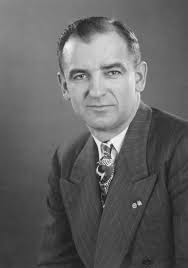
Joseph R McCarthy courtesy Wikipedia

 You don't have to look very far in recent American political history, gentle reader, to find a figure resembling Donald Trump.

That figure, Joseph McCarthy, the Senator from Wisconsin, who was prominent from 1950 until 1954, until he was censured by the Senate, had galvanised public opinion around the issue of alleged Communist subversion in American institutional life. 

McCarthy's activities for that relatively brief period of time, had an impact well beyond both the span of his crusade, and the walls of the US Senate.

The combination of power, fame and falsehood has always held a magnetic attraction for the US media. In a country where there is no publicly funded media of any real consequence, corporations that make a profit by selling copy (print or digital) will always be attracted to what is loud, exciting and simple. 

This monopolising of the spotlight is an important pathway to political power across the Pacific. There are any number of cliches bearing witness to the phenomenon. There is no such thing as bad publicity. is just one of those cliches, and one that Trump understands very well.

Trump, either consciously or instinctively, is well aware of this phenomenon and has exploited it adroitly. This exploitation has taken on a sinister turn recently, with his administration's attempt to push aside media agencies that challenge his narrative.

He has also demonstrated that he is prepared to take on many institutions previously protected by their status, including the churches, the courts, and the military.

McCarthy met his demise when he took on the US military, and after he was denounced by Edward R Murrow, a highly respected broadcaster, he quickly lost favour and with it, attention. 

Unfortunately, by that time he had done a great deal of damage during the half a decade of his notoriety. Anti-communist hysteria spread beyond the shores and institutions of the USA, and had an influence in Australian politics lasting well into the early sixties.

Our tragic adventure in Vietnam was just one outcome. Echoes persist even today. They're all over social media.

Social media thrives on memes that are loud, exciting and simple.

Social media is a good earner for a few. It has become a parasite feeding on rumour, fear, and outrage, and the platforms are lining up to take advantage of the spoils. 

That fact that it influences the outcomes of elections and is being harnessed by political operatives is perhaps the most worrying aspect of all.  


The Details Matter

  Note one chrome mirror - one black plastic. Australian politics and international affairs have recently become something resembling a fail...