Showing posts with label pandemic.. Show all posts

Monday, 18 March 2024

Taken for Granted

Pic courtesy Leader Today

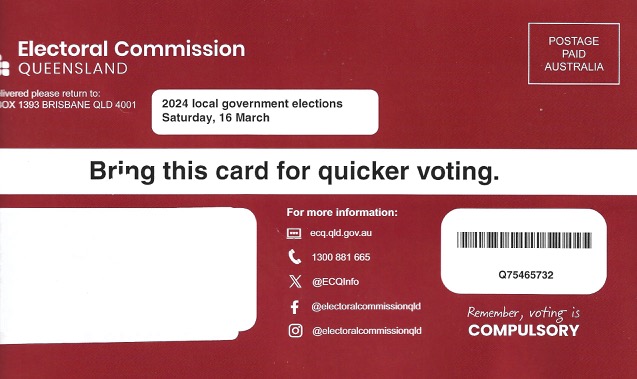
Yesterday I went to the state school down the road, and voted in the local government elections, something I've been doing for years, and something entirely unremarkable. 

 But is it? 

 We've only to take a glance to the East, across the Pacific at the U.S., or Northwest,  to the Russian Federation, to understand that our electoral system is entirely remarkable. 

We're not the only country to have compulsory suffrage, but it goes well beyond that.

To use that much-maligned "mutual obligation" term, if the law demands that you vote, it has to provide you the facility and infrastructure to do so. Hence, state and federal electoral commissions, regulated boundaries, and a standardised and transparent vote counting process have been developed over the years.

The foundation of our system is the maintenance of an up-to-date electoral roll. We don't always appreciate the fact that the maintenance of this critical data is humming away quite efficiently in the background, except perhaps when we receive the note in our letterbox reminding us that an election is on the way, and we have to vote.

People who arrive at the age to vote are also encouraged to enrol, although many don't follow through. That seems to be changing, which can only be a good thing.

Enrolling to vote is encouraged at school, and most young people in my experience are enthusiastic first-time voters. I certainly was, when my first opportunity to vote came up at the 1969 Federal election. At the time, I was at the Jungle Training Centre at Canungra, preparing as a conscript, for operational service in Vietnam.

I was, to say the least, disappointed, when I went to the orderly room seeking transport to Canungra State School to vote, only to be told that if I left the centre, I'd be charged with being AWOL*.

Somehow, the notion that we were ostensibly fighting for democracy seemed lost on the army at the time.

This experience has driven home to me the value of our system, as I was voting for a decision about my immediate future, and I was given no say in it. I wonder how many of the 200 National Servicemen who died in Vietnam actually got to vote on the issue?

Contrasting our system with that in the "democracy" across the Pacific is revelatory. The quotes are intentional, by the way, as the US is not a democracy, but a constitutional republic. 

It's electoral college system, the history of the disenfranchisement of minorities, and its bipartisan tradition of electoral gerrymandering are well known, although not always well understood outside of the USA.

The fact that 62% of US voters turned out at the 2020 presidential poll, gives the lie to an application of the term "democracy" as applied to the USA when you consider that 38% had no say. The turnout in 2020 was one of the highest on record, and an improvement on the 52% in 1952. Voter suppression of minorities has decreased, but it continues in many southern states.

Perhaps the greatest advantage of a compulsory system is that no encouragement is needed to get people out to vote. In countries where voting is voluntary, you need to get people angry or frightened to get them to the ballot box. Anger and fear are very dangerous emotions, and the results are usually the election of those who use anger and fear, rather than hope, to secure power.

So gentle reader, be thankful that you live in a country where participation is understood the be the cornerstone of democracy, and don't ever take it for granted.


*Absent without leave.


Monday, 28 November 2022

Media Bias


The Victorian state election has been and gone, and the ALP has been returned with Daniel Andrews as Premier.

As a Queenslander, this event is of peripheral interest to me, but there is one aspect of the campaign and the result that is more than remarkable.

Elements of the Victorian media ran a sustained and relentless campaign against his re-election. It was characterised by the introduction into the discussion of events that had absolutely nothing to do with Andrew's policies, but focused on two fairly recent events involving himself and his family.

The first was a motor accident that involved a collision between Andrew's Ford Territory and a cyclist on 7th January 2013. The cyclist was badly injured, but did recover, losing his spleen. The police took no action after an investigation and statements describing the incident as - 

Cyclist was travelling along the unpaved surface road and crossed Ridley Street into the vehicle as it turned right. Cyclist collided with the front drivers side of the vehicle, causing the cyclist to be ejected onto the windscreen, causing it to smash. 

Photographs of the vehicle published by the Sun Herald show damage to the area in front of, but to the side of the vehicle's mudguard, and the smashed windscreen. This is consistent with statements given to the police by Mrs Andrews.

The accident happened in 2013, nine years ago, and after the initial reports had largely been forgotten. It is then resurrected two weeks before the election together with lurid claims of a police cover-up.

The Sun-Herald produced front page coverage for a number of days, and the outrage was picked up by Melbourne shock jocks who dined out on it right up until the eve of the election.

Then there was the story of an accident on 9th March 2021 when Andrews fell on wet stairs whilst on holiday on the Mornington Peninsula. He was placed in intensive care after this incident which caused several broken ribs and a broken vertebra. Andrews took four months to recover from this incident, which generated all manner of conspiracy theories on social media, and generated front page coverage (again by the Sun Herald) on Sunday, November 6th, a few weeks before the election. 

Again, this accident happened over a year ago.

Herald Sun November 6th 2022

This accident had absolutely nothing to do with the election campaign, but was used in a clumsy attempt to smear Andrews.

Now these media organisations have to make money, but the issue of ethics of how this is done seem somehow to have vanished into the ether. There appears to be no real accountability, and the Press Council (as I learned many years ago) is a toothless tiger.

And of course, media can publish opinion, but when they actively campaign (rather than report) in the lead up to an election, they should at least be honest enough to inform their readers.

In the end, none of this seems to have influenced Victorian voters. A Royal Commission into media ownership and bias is beginning to look like a pretty good idea.


Friday, 5 August 2022

On Lazy Cliche

Pic courtesy prowritingaid

You've encountered them, gentle reader. 

Lazy cliches are everywhere. Once upon a time they were used in everyday conversation by everyday people.

Frankly, I have no problem with that, but when they crop up in what is seen as professional journalism, I draw a line.

Let's list a few -

"Icon" or "iconic" (overused, and as a consequence, meaningless).

"Incredible" (favoured by young and breathless on-line reporters).

"Literally" (usually means exactly the opposite)

"Ironic" (as ubiquitous as "iconic" and just as meaningless) 

"A cautionary tale" (tales are boring if they're cautious)

"Cautiously optimistic" (I'd prefer recklessly optimistic)

"Needless to say" (then don’t say it)
"Anything" gate (Why?)
"Part and parcel" (again, meaningless) 
These things sneak into the language and propagate like a virus. Unfortunately, there's no vaccination. The cure is copy editors, but with their demise, and the growth of digital content, it's not going to happen.

Comments Closed.

Friday, 19 February 2021

Some Reflections on Quarantine


Medical staff in Surry Hills, NSW, 1919. Pic courtesy NSW Archives

By now, every state in the commonwealth, with the exception of the Northern Territory has had to resort to at least one snap lockdown because of failures in the hotel quarantine system.

This system works most of the time, but when it breaks down, the results are not pretty, from the point of view of both health and economic outcomes.

Quarantine was used extensively in the Spanish Flu pandemic of 1918, and to a large extent, it did help Australia to get through the episode with a much lower infection rate than many other countries at the time.

Historical accounts describe two different programmes, one maritime and the other land, the first apparently much more successful than the second. The land quarantine camps (as they were called) were set up adjacent to state borders, whereas the maritime stations were set up near embarkation points in the major cities.

All states had quarantine stations (North Head in New South Wales, Port Nepean in Victoria, Bruny Island in Tasmania, Torrens Island in South Australia, Woodman Point in Western Australia, and Lytton in Brisbane) but many more were planned in case numbers overwhelmed their capacity. In due course, temporary quarantine stations and influenza hospitals were set up to handle the increasing volume of affected Australians.1

The maritime stations were apparently relatively effective, but the state border stations were not. People frequently bought their way out or escaped because it was easy to do so. The maritime stations were often set up offshore or in inaccessible locations, so escape was often impossible. These places weren't remote, but they were designed in 1918 to be inaccessible.

Perhaps we can learn from history. Scattered throughout the country are a number of mothballed commonwealth owned and run facilities, mostly detention centres. they include Baxter IRPC* (Cultana SA), Christmas Island IRPC, Curtin IRPC (Curtin WA), Howard Springs Quarantine Facility (NT), Inverbrackie APD# (Woodside SA), and Leonora APD (WA). There are also facilities at Port Augusta and Port Hedland.

What they have in common with the quarantine centres used in 1916 is their inaccessibility.

Christmas Island (which cost the Australian taxpayer $180 million to be reopened when the medical evacuation legislation was passed by parliament) is almost empty. Currently, it houses a family of four from Sri Lanka, although was used briefly to quarantine repatriated Australians last year.  

Most of these facilities use pre-fabricated structures and resemble mining camps in that they consist of separate buildings that don't share ventilation and air-conditioning systems, unlike hotel accommodation currently used for quarantine in our state capitals. Virologists are telling us that self-contained and spread accommodation is much better at preventing the spread of virus than your typical multi-storeyed city hotel. 

Most are located close to airbases with runways of sufficient length to cater for international flights. All are self-contained with catering and laundry facilities attached.

The ADF has currently a strength of just over 85000 full-time personnel and active reservists across the three services. 

Combining personnel, these locations, and a realistic allocation from the defence budget, a number of these centres could be set up as quarantine facilities. They could be staffed with soldiers, sailors and airmen/women, who might be happy to work a FIFO stint for a limited specified period. Infantry soldiers (for example) might be grateful for beds and air-conditioning. Who knows - down the track, personnel who served in these locations could be rewarded with a special Covid medal, similar to that awarded to peacekeepers. I'm only half-joking.

The risk of staff working multiple jobs and locations would be eliminated, and the possibly infected travellers would be housed a long way from major population centres, not smack in the middle of them as currently arranged.

Those in quarantine would probably prefer a self-contained demountable to stuffy hotel rooms with balcony and corridor access off-limits. After all, if you're going to be stuck in quarantine for a fortnight, whether you're in a metropolitan hotel, or a donga in the bush is neither here nor there.

And breaches of security protocols amongst staff (the major cause of the transmitted infections) are probably a bit more unlikely in a military environment than a civilian one. There's always the threat of an A4.

This notion has already taken wings with a couple of entrepreneurs (Wagner in Toowoomba, and Fox at Tullamarine) which strongly suggests that it's feasible.

Strangely, immigration and quarantine are commonwealth responsibilities, but they have been duck-shoved, on this occasion, to the states. Using commonwealth facilities and personnel would put this process in the hands of the level of government responsible.

Anything has to be an improvement on lightning lockdowns.

*Immigration Reception and Processing Centre

#Alternative Place of Detention

1. The Navy and the 1918-19 Flu Epidemic, by Greg Swinden


Comments closed.

The Details Matter

  Note one chrome mirror - one black plastic. Australian politics and international affairs have recently become something resembling a fail...