![]() |
| From left - Bob Hughes, Allan Aldenhoven and John Walker. (Pic courtesy AWM) |
![]() |
| Colin (Charlie) Tilmouth |
![]() |
| From left - Bob Hughes, Allan Aldenhoven and John Walker. (Pic courtesy AWM) |
![]() |
| Colin (Charlie) Tilmouth |
![]() |
| Image courtesy Reuters |
![]() |
| Image courtesy Medscape |
The last time I was an inpatient is a hospital was when I had my tonsils out at age four. Courtesy of a pulmonary embolism, I now find myself an inpatient after an emergency admission on Sunday.
Modern hospitals are interesting places. There are a variety of systems which generally work like well oiled machines and most often allow for effective monitoring of vital signs.
For the first few days of my treatment I was kitted out with a device which recorded my oxygen levels and heart rate in real time and transmitted the information to a screen in the nurses station. It was attached to my chest with stickers and cables, and was only a problem when I needed to shower, as the stickers had to be removed and replaced.
One benefit of this device was that it removed the requirement to be woken at stupid hours to have vital signs checked. Blood pressure could not be measured using this thing, so I still had to be disturbed for that, but that was only once during weird hours, so I was glad of the lumpy technology. It’s amazing what you can put up with sleep wise when it’s necessary.
The only time I had a problem with the monitoring was when I got a little stir-crazy and went for a walk to the cafeteria for a coffee.
The upshot was that the device started beeping, set an alarm at the nurses station, and caused consternation when they went to my room to find me absent.
I was spoken to very sternly….
![]() |
| Image courtesy 6PR |
I have never met Normie Rowe, but have deep respect for him as a fellow Vietnam veteran and Nasho. He left Vietnam just before I got there, but I certainly travelled in APCs belonging to his unit (3 Cav) in 1970.
It was noisy, but beat walking. It helped to forget about land mines....
Rowe is also a very talented musician. The post is attributed to Normie, but without actually asking him, gentle reader, I won't know whether he wrote it or not.
In any case, I'm interested in the facts of history, not (in this case) how a Vietnam veteran (including a respected celebrity) allegedly reflects on his experience. There is a time and place for that.
I find myself agreeing with much of what is attributed to Rowe in the post, especially his remarks about conscription being a political exercise.
The part that doesn't hold water refers to an anecdote about the deathbed confession by an advisor to Harold Holt. All Normie writes is that he'd heard the anecdote. He makes no judgement about whether it is real.
To cut to the chase, the post alleges that Normie ended up as a conscript because the government believed that calling up a celebrity would improve public support for the scheme, support that had never been on firm ground. The substance of the myth is that his birthdate was never drawn, and that he was enlisted as a publicity stunt.
Indeed, his birthdate (1st February 1947) was not drawn in the fifth intake on 10th March 1967, but that was irrelevant as he hadn't registered. He was absent from Australia at the time making music in the UK.
He was required to register when he got home, and did so, in one of the fifteen supplementary ballots held during the course of the scheme. There were sixteen regular ballots, one more than the supplementary ones. I had registered in the normal ballot he missed and my birthdate was drawn in that 10th March ballot. Strangely, that's my bride's birthday, although we hadn't met at the time.
The routine supplementary ballot was held for those registering on return to Australia, and Normie's birthdate was drawn. He was enlisted in January 1968, assigned the regimental number 3793130, did recruit training and was allocated to Armoured Corps.
He was in Vietnam from 14th January until 19th December 1969.
The myth has been bouncing around the interweb for years, and has been debunked before, but it persists. It featured on Media Watch in March 2008.
I was at a meeting of ex-Nashos the other day, and heard the myth being floated again. I had my iPad with me and was able to show the ex-Nasho who was proclaiming it, chapter and verse showing the Normie's birthdate drawn in the supplementary ballot.
It made no difference, and we parted with his belief in the myth still firm. He claimed the whole thing (including the record of the supplementary ballot draws) was a government conspiracy.
Obviously, the myth is more entertaining than the history.
The rationale of "shared values" is routinely advanced by our political class to support the notion that we should, as a matter of policy, go along with much of what is happening under the Trump administration at the moment.
Given that, it would be useful to examine just which values we share with Americans, at both the individual and community level. This is difficult, in the first instance, because the diversity that exists across populations in both countries makes it difficult to determine what those individual values are.
Would an African-American from Chicago hold the same values as a white American from the Midwest, or a Latino from Texas? Would a hipster from urban Melbourne hold the same set of values as a wheat farmer from Merredin, or a Murri from Dajarra?
The answer, of course, is that individual comparisons and assumptions simply do not hold, so we will have to look at institutional and political values.
AI will tell you that Australian values respect mateship, and the notion of a "fair go', whereas Americans value individual achievement, free will, and economic success. The institutional outcomes of these factors are universal health programmes, strong social security and welfare structures in Australia, and private insurance and a relatively scelorotic welfare system in the USA.
It describes an Australian laid back attitude to leadership, and a lack of deference to authority, whereas Americans respect authoritative leaders and those in positions of power. These values feed consensus (not weak) politicians in Australia, and authoritarian leadership in the USA. The current situation mirrors that.
It says Australians have a more relaxed approach to the work-life balance, and focus more on enjoying life than making money, but Americans value career advancement and are tolerant of long working hours.
The cliche of the tall poppy syndrome is cited in Australia, but Americans are painted as admiring "superstars" and those who are very successful.
And when it comes to class structure, Americans are described as categorising people by status, whereas Australia has a relatively low degree of class structure.
Frankly, I believe that there is confusion generated by the fact that we share a common language and there are strong parallels in our national history narrative, as we are post colonial societies which began as British settlements. These commonalities mask or hide significant differences.
These differences were demonstrated starkly to me when I served beside Americans in Vietnam fifty five years ago. I vividly remember situations where the hierarchical culture of many American military units got in the way of getting the job done. As Australians, we often exploited this culture when we were scrounging for materials. It was very easy to use rank as a wedge to get what we wanted.
The attitude towards race demonstrated by the Americans was in strong contrast to ours. We saw indigenous diggers as of equal status. The Americans didn't, and this was sometimes a source of tension when we fraternised with African-American soldiers when on leave.
I remember being pulled aside by a well-meaning GI in a nightclub in Saigon, and being told "You don't want to associate with those motherfuckers". He was referring to a group of black Southerners who were great and generous company.I saw these same attitudes, especially to race and status, when I visited the USA in 2018. Nothing has changed in half a century.
We need something more solid than that, given what is at stake.
![]() |
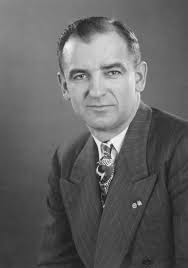
| Joseph R McCarthy courtesy Wikipedia |
You don't have to look very far in recent American political history, gentle reader, to find a figure resembling Donald Trump.
That figure, Joseph McCarthy, the Senator from Wisconsin, who was prominent from 1950 until 1954, until he was censured by the Senate, had galvanised public opinion around the issue of alleged Communist subversion in American institutional life.
McCarthy's activities for that relatively brief period of time, had an impact well beyond both the span of his crusade, and the walls of the US Senate.
The combination of power, fame and falsehood has always held a magnetic attraction for the US media. In a country where there is no publicly funded media of any real consequence, corporations that make a profit by selling copy (print or digital) will always be attracted to what is loud, exciting and simple.
This monopolising of the spotlight is an important pathway to political power across the Pacific. There are any number of cliches bearing witness to the phenomenon. There is no such thing as bad publicity. is just one of those cliches, and one that Trump understands very well.
Trump, either consciously or instinctively, is well aware of this phenomenon and has exploited it adroitly. This exploitation has taken on a sinister turn recently, with his administration's attempt to push aside media agencies that challenge his narrative.
He has also demonstrated that he is prepared to take on many institutions previously protected by their status, including the churches, the courts, and the military.
McCarthy met his demise when he took on the US military, and after he was denounced by Edward R Murrow, a highly respected broadcaster, he quickly lost favour and with it, attention.
Unfortunately, by that time he had done a great deal of damage during the half a decade of his notoriety. Anti-communist hysteria spread beyond the shores and institutions of the USA, and had an influence in Australian politics lasting well into the early sixties.
Our tragic adventure in Vietnam was just one outcome. Echoes persist even today. They're all over social media.
Social media thrives on memes that are loud, exciting and simple.
Social media is a good earner for a few. It has become a parasite feeding on rumour, fear, and outrage, and the platforms are lining up to take advantage of the spoils.
That fact that it influences the outcomes of elections and is being harnessed by political operatives is perhaps the most worrying aspect of all.
![]() |
| Police station and residence. The government house we lived in was identical. |
We've been minimally effected, and apart from my bush house doing the watusi which meant that everything on its shelves ended up in a heap on the floor, life has proceeded as usual.
Tropical cyclones are part of my lived experience, having grown up in north Queensland, and my earliest memories are those surrounding a cyclone which crossed the coast at Carmila on March 11th 1950. I was about three at the time, but can remember parts of it, including sheltering under a sturdy oak table in our kitchen whilst the school residence broke up around us.
This link takes you to a newspaper account in the Townsville Daily bulletin of 13th March 1950. It took two days for the full story to get through, a contrast to the real time reporting we're seeing today. Dad gets a mention in the report.
The house lost all its corrugated iron roof, and part of the gable end at the front. We were obliged to live in the school for a couple of weeks whilst the residence was re-roofed.
Another early memory was the smell of burning linen. A family down the road from us also moved into the school, and one of them came down with Tuberculosis. Back then, we were advised to burn all bed linen used by this family. My mother had taken bed linen out of storage which had been a wedding gift, and loaned it to this family.
![]() |
| Repair crew that was sent into Carmila by rail. |
Mum was very upset when it had to be burned, and I recall the smell, and her distress.
Since then, I lived in Townsville for a while, and was there when cyclone Aivu crossed the coast near the Burdekin River between Townsville and Bowen on April 4th 1989. Whilst that cyclone didn't do a great deal of damage around Townsville, it caused lots of flooding to the north, and for a while looked to be a major threat.
This may have been why, given my recall of the Carmila experience, I moved my family overnight to my new school which had been built to cyclone proof standards in 1987. I rationalised that if the school was going to be declared a cyclone, I would be prepared by being on site.
As I write this, in Queensland, at least, no lives have been lost, although the same can't be said for Northern NSW.
And the term "Cockeyed Bob?" I haven't heard it used for decades, but apparently it was once applied to severe and unpredictable storms.
That would describe Alfred.
Image Courtesy The Echo Kerry O'Brien's Thea Astley address at the Byron Bay's writer's festival on Saturday 15th August i...