Friday, 2 May 2025

A Cautionary Tale

Pic Courtesy Scamwatch

Until a few days ago, gentle reader, I thought I was scam-proof. I've always avoided the usual traps (clicking on links in emails, etc) and am security conscious to the point of hypervigilance.

Not so.

Two days ago, I had my card refused at the bakery early in the morning, so paid cash, wondering what was going on.

I had been home only a few minutes when my bank phoned saying there had been suspicious activity on my card (overseas transaction). Once they knew it was an unauthorised transaction, they gave me the option of cancelling my card, or letting me monitor transactions closely.

I chose the latter because I didn't want to be lumbered with using cash until a new card arrived.

Then, almost on cue, an email arrived, telling me to contact PayPal because there was unauthorised activity on my account. I checked the account, and indeed there was a transaction (purchase of antivirus software) that I had not authorised.

(I use PayPal to sell my book).

I phoned the number on the email, and then began a long conversation with someone who sounded South Asian, was very polite, and had all my details at his fingertips.

The problem was, he wasn't working for PayPal. He was a very sophisticated scammer who had set up a successful ambush. If I had checked the number when I logged into PayPal and found it was different, I would have realised what was going on, but I didn't.

Over about twenty minutes he kept me on the line whilst he claimed he was ensuring my account was secure. He wasn't. He was moving funds from my account using money transfer Apps which he convinced me to download to my phone, on the pretext that he would use them to test the security settings.

At this point I became suspicious, especially when he heard me talking to my bride, who by this time, was also becoming suspicious. He asked me who else was on the call.

I hung up, and phoned my bank. After the usual identity process, they put me through to their security team, who confirmed that $5000 in two separate transactions had been removed from my account.

A prolonged conversation ensued, during which the bank agent sought as much detail as I could provide. It was a very thorough interrogation, and apparently useful.

The bank retrieved the funds overnight, but my card was cancelled, and access to my online banking denied until I could get the two devices I used (iMac and iPhone) certified cleaned. 

This involved cost and inconvenience, and the technician involved told me he was getting an average of five jobs a week cleaning and certifying devices which had been used by scammed customers. 

There are a couple of lessons. One is never to phone a number on an email, until you're absolutely certain it is genuine. It's easy to do so by checking the origin address on the email. I didn't - first time ever.

The other is to follow your instincts, which I subsequently did by terminating the call, but not before the damage was done.

I was very impressed by the thoroughness of the bank, and their persistence in securing the return of the funds. I'm not entirely sure how that was done. Readers may make suggestions through commentary.

I dodged a bullet...


Tuesday, 22 April 2025

In Memoriam

From left - Bob Hughes, Allan Aldenhoven and John Walker. (Pic courtesy AWM)


Today, gentle reader, is the fifty-fifth anniversary of B Coy, 7 RAR's encounter with a bunker system at grid reference 588698 near a feature which the operational maps called the "bone".

I remember it as if it were yesterday.

We had, as a company, a number of fleeting contacts leading up to the action which had indicated that VC were active in the area. It was the middle of the dry season, and access to water was an issue both for us, and whatever VC were around.

At the end of the encounter, all three platoons had taken casualties - 4 platoon one KIA (Bob Hughes), and one WIA (Karl Metcalf), 5 platoon one WIA (Colin Tilmouth), and 6 platoon (Graham Kavanagh) who died of dehydration on the 21st, the day before we hit the bunkers.

We had been inserted into the AO on the 19th April by patrolling all night along the dry creek bed of a stream called the Suoi Lho O Nho, led by Karl Metcalf, OC 4 platoon. Karl's navigation skills saw the whole company safely arrive in the AO. Most of us were exhausted at the end of the insertion, as we had stumbled for hours in the pitch dark along a rocky creek bed in close single file, fully laden with rations, water and ammunition, and immediately following a period of R & C at Vung Tau, when we'd drunk plenty of beer and other local concoctions. 

A number of men in my (5) platoon had collapsed by the time we arrived, and apparently the same was happening to other callsigns and Graham Kavanagh (6 platoon) had collapsed and became progressively weaker as time passed. I remember seeing a group of soldiers clustered around him as we passed through their position. He died of severe dehydration just before a medivac chopper turned up.

Graham Kavanagh's medical report. (Note misspelling).

Doug Gibbons (OC 5 platoon) had taken a half platoon squad out mid-morning on the 22nd to patrol along a dry creek, and it was a sentry from the bunker system that opened up on that patrol. Colin Tilmouth was wounded and choppered out, after Doug Gibbons retrieved him.

Colin (Charlie) Tilmouth


4 platoon,  led by Karl Metcalf, assaulted the bunkers, and the VC used RPGs to repel them. It was shrapnel from an RPG round fired into a tree that killed Bob Hughes. I was part of a half platoon group that remained as a blocking force on the banks of the dry gully whilst all this was going on. Looking back on it, it was only dumb luck that spared me, and others from my section, from participating in the assault. 

After an afternoon when artillery, a light fire team (Bushranger gunships), and USAF F-100s joined in to attack the bunkers, tanks were summoned. It took them the best part of the evening to turn up, and by then it was too dark to move on the bunkers. Apparently, the combination of tanks, infantry and darkness would not have been conducive to a successful assault.

Next morning the tanks moved in and destroyed the bunkers, but the VC had (wisely) decamped.

This was our first serious contact as a company, and the second time we had been under fire. The first time was when 4 platoon opened up on us on 13th March in a friendly fire incident when Paul Lusk was wounded. I was patrolling next to him at the time, and the incident remains firmly implanted on my memory. Being on the receiving end of a volley of M60 concentrates the mind.

So today, I remember Bob Hughes, Graham Kavanagh and Colin Tilmouth (who was repatriated to Australia, and died in 1990).

May they rest in peace, and their memory be honoured. 

Sed pro gratia dei.....

Saturday, 19 April 2025

History Rhymes Again

Image courtesy Reuters

During my short stay in hospital, gentle reader, I did a little reading. 

One of the books I read quickly (easily achieved in a hospital when you are waited on, and aren't interrupted by routine necessary chores) was Mosquito by Rowland White.

I was interested in it because I have an obsession with military aircraft, and find the topic interesting because of personal experience in a variety of these machines in my short and unspectacular military career.

It's an engaging narrative, but more because of its behind-the scenes portrayal of the Danish resistance in World War Two than technical aspects of the aircraft.

De Havilland Mosquitos were used in a spectacular raid on the Shellhaus Gestapo Headquarters in Copenhagen and dropped supplies and personnel to resistance groups. 

They also routinely transported ball bearings from Sweden to the UK to maintain the supply of these much needed components during the height of British aircraft construction during the early stages of the conflict.

But what I hadn't expected to find in this monograph was a the simultaneous contextual outline of the Nazi occupation of Denmark, which was portrayed by the Third Reich's propaganda as an exercise in peaceful cooperation between the Danish authorities and the Nazis.

It wasn't, of course, and when the Danish resistance, supported by the allies, began to have an effect the Nazis retaliated.

This retaliation consisted of rounding up about five hundred Jewish members of the Danish community and transporting them to the Theresienstadt ghetto in Czechoslovakia. 

It could have been a lot worse. Many Danes, with the help of the resistance organised a massive rescue effort. The used boats to ferry Jews across the Oresund strait to Sweden, in an operation coordinated by the resistance, and involving ordinary citizens and some brave members of the Danish police and government. Over seven thousand were saved.

Images of people being herded into railway wagons in August 1943 put me in mind of a similar phenomenon taking place right now in the USA, a country once considered a bastion of democracy. 

The people targeted for deportation into South American Gulags in El Salvador aren't Jews. They're allegedly gang members.  The process is however eerily similar, separated as it is by over eighty years and taking place in different continents..

Again, history rhymes.... 
 

Thursday, 10 April 2025

Medicine and Technology

 Image courtesy Medscape

I've been a bit lucky, gentle reader, when it comes to hospital admissions across my seventy-seven years.

The last time I was an inpatient is a hospital was when I had my tonsils out at age four. Courtesy of a pulmonary embolism, I now find myself an inpatient after an emergency admission on Sunday.

Modern hospitals are interesting places. There are a variety of systems which generally work like well oiled machines and most often allow for effective monitoring of vital signs. 

For the first few days of my treatment I was kitted out with a device which recorded my oxygen levels and heart rate in real time and transmitted the information to a screen in the nurses station. It was attached to my chest with stickers and cables, and was only a problem when I needed to shower, as the stickers had to be removed and replaced.

One benefit of this device was that it removed the requirement to be woken at stupid hours to have vital signs checked. Blood pressure could not be measured using this thing, so I still had to be disturbed for that, but that was only once during weird hours, so I was glad of the lumpy technology. It’s amazing what you can put up with sleep wise when it’s necessary.

The only time I had a problem with the monitoring was when I got a little stir-crazy and went for a walk to the cafeteria for a coffee.

The upshot was that the device started beeping, set an alarm at the nurses station, and caused consternation when they went to my room to find me absent.

I was spoken to very sternly….


Thursday, 27 March 2025

Mythbusting


Image courtesy 6PR

I came across this post the other day.

I have never met Normie Rowe, but have deep respect for him as a fellow Vietnam veteran and Nasho. He left Vietnam just before I got there, but I certainly travelled in APCs belonging to his unit (3 Cav) in 1970. 

It was noisy, but beat walking. It helped to forget about land mines....

Rowe is also a very talented musician. The post is attributed to Normie, but without actually asking him, gentle reader, I won't know whether he wrote it or not. 

In any case, I'm interested in the facts of history, not (in this case) how a Vietnam veteran (including a respected celebrity) allegedly reflects on his experience. There is a time and place for that

I find myself agreeing with much of what is attributed to Rowe in the post, especially his remarks about conscription being a political exercise. 

The part that doesn't hold water refers to an anecdote about the deathbed confession by an advisor to Harold Holt. All Normie writes is that he'd heard the anecdote. He makes no judgement about whether it is real.

To cut to the chase, the post alleges that Normie ended up as a conscript because the government believed that calling up a celebrity would improve public support for the scheme, support that had never been on firm ground. The substance of the myth is that his birthdate was never drawn, and that he was enlisted as a publicity stunt. 

Indeed, his birthdate (1st February 1947) was not drawn in the fifth intake on 10th March 1967, but that was irrelevant as he hadn't registered. He was absent from Australia at the time making music in the UK. 

He was required to register when he got home, and did so, in one of the fifteen supplementary ballots held during the course of the scheme. There were sixteen regular ballots, one more than the supplementary ones. I had registered in the normal ballot he missed and my birthdate was drawn in that 10th March ballot. Strangely, that's my bride's birthday, although we hadn't met at the time.

The routine supplementary ballot was held for those registering on return to Australia, and Normie's birthdate was drawn. He was enlisted in January 1968, assigned the regimental number 3793130, did recruit training and was allocated to Armoured Corps.

He was in Vietnam from 14th January until 19th December 1969.

The myth has been bouncing around the interweb for years, and has been debunked before, but it persists. It featured on Media Watch in March 2008.

I was at a meeting of ex-Nashos the other day, and heard the myth being floated again. I had my iPad with me and was able to show the ex-Nasho who was proclaiming it, chapter and verse showing the Normie's birthdate drawn in the supplementary ballot. 

It made no difference, and we parted with his belief in the myth still firm. He claimed the whole thing (including the record of the supplementary ballot draws) was a government conspiracy.

Obviously, the myth is more entertaining than the history.


Monday, 24 March 2025

Shared Values - Take two


Monthly value of US merchandise exports to Australia (A$ millions) since 1988

Monthly value of Australian merchandise exports to the United States (A$ millions) since 1988

Pics courtesy Wikipedia

I've posted about this before, but the issue is much more significant now.

The rationale of "shared values" is routinely advanced by our political class to support the notion that we should, as a matter of policy, go along with much of what is happening under the Trump administration at the moment.

Given that, it would be useful to examine just which values we share with Americans, at both the individual and community level. This is difficult, in the first instance, because the diversity that exists across populations in both countries makes it difficult to determine what those individual values are.

Would an African-American from Chicago hold the same values as a white American from the Midwest, or a Latino from Texas? Would a hipster from urban Melbourne hold the same set of values as a wheat farmer from Merredin, or a Murri from Dajarra?

The answer, of course, is that individual comparisons and assumptions simply do not hold, so we will have to look at institutional and political values.

AI will tell you that Australian values respect mateship, and the notion of a "fair go', whereas Americans value individual achievement, free will, and economic success. The institutional outcomes of these factors are universal health programmes, strong social security and welfare structures in Australia, and private insurance and a relatively scelorotic welfare system in the USA.

It describes an Australian laid back attitude to leadership, and a lack of deference to authority, whereas Americans respect authoritative leaders and those in positions of power. These values feed consensus (not weak) politicians in Australia, and authoritarian leadership in the USA. The current situation mirrors that.

It says Australians have a more relaxed approach to the work-life balance, and focus more on enjoying life than making money, but Americans value career advancement and are tolerant of long working hours. 

The cliche of the tall poppy syndrome is cited in Australia, but Americans are painted as admiring "superstars" and those who are very successful.

And when it comes to class structure, Americans are described as categorising people by status, whereas Australia has a relatively low degree of class structure.

Frankly, I believe that there is confusion generated by the fact that we share a common language and there are strong parallels in our national history narrative, as we are post colonial societies which began as British settlements. These commonalities mask or hide significant differences.

These differences were demonstrated starkly to me when I served beside Americans in Vietnam fifty five years ago. I vividly remember situations where the hierarchical culture of many American military units got in the way of getting the job done. As Australians, we often exploited this culture when we were scrounging for materials. It was very easy to use rank as a wedge to get what we wanted.

The attitude towards race demonstrated by the Americans was in strong contrast to ours. We saw indigenous diggers as of equal status. The Americans didn't, and this was sometimes a source of tension when we fraternised with African-American soldiers when on leave.

I remember being pulled aside by a well-meaning GI in a nightclub in Saigon, and being told "You don't want to associate with those motherfuckers". He was referring to a group of black Southerners who were great and generous company.I saw these same attitudes, especially to race and status, when I visited the USA in 2018. Nothing has changed in half a century.

In summary, I believe that the rationalisation of "shared values" as a basis for our alliance is mythology.

We need something more solid than that, given what is at stake.


Monday, 17 March 2025

The Power of Attention


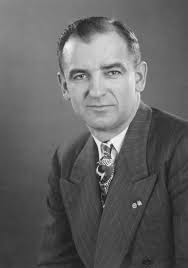
Joseph R McCarthy courtesy Wikipedia

 You don't have to look very far in recent American political history, gentle reader, to find a figure resembling Donald Trump.

That figure, Joseph McCarthy, the Senator from Wisconsin, who was prominent from 1950 until 1954, until he was censured by the Senate, had galvanised public opinion around the issue of alleged Communist subversion in American institutional life. 

McCarthy's activities for that relatively brief period of time, had an impact well beyond both the span of his crusade, and the walls of the US Senate.

The combination of power, fame and falsehood has always held a magnetic attraction for the US media. In a country where there is no publicly funded media of any real consequence, corporations that make a profit by selling copy (print or digital) will always be attracted to what is loud, exciting and simple. 

This monopolising of the spotlight is an important pathway to political power across the Pacific. There are any number of cliches bearing witness to the phenomenon. There is no such thing as bad publicity. is just one of those cliches, and one that Trump understands very well.

Trump, either consciously or instinctively, is well aware of this phenomenon and has exploited it adroitly. This exploitation has taken on a sinister turn recently, with his administration's attempt to push aside media agencies that challenge his narrative.

He has also demonstrated that he is prepared to take on many institutions previously protected by their status, including the churches, the courts, and the military.

McCarthy met his demise when he took on the US military, and after he was denounced by Edward R Murrow, a highly respected broadcaster, he quickly lost favour and with it, attention. 

Unfortunately, by that time he had done a great deal of damage during the half a decade of his notoriety. Anti-communist hysteria spread beyond the shores and institutions of the USA, and had an influence in Australian politics lasting well into the early sixties.

Our tragic adventure in Vietnam was just one outcome. Echoes persist even today. They're all over social media.

Social media thrives on memes that are loud, exciting and simple.

Social media is a good earner for a few. It has become a parasite feeding on rumour, fear, and outrage, and the platforms are lining up to take advantage of the spoils. 

That fact that it influences the outcomes of elections and is being harnessed by political operatives is perhaps the most worrying aspect of all.  


The Details Matter

  Note one chrome mirror - one black plastic. Australian politics and international affairs have recently become something resembling a fail...