Saturday, 14 May 2022

The Pandemic and the Media


Australia - Total Cases - Courtesy Worldometers* 

I'm sure that you remember, gentle reader, the daily news conferences (at state and federal level) that were broadcast during the first two years of the pandemic.

In most households they were routine viewing.  Usually the premier or PM (flanked by a coterie of health officials) would go into great detail about the significance of the daily figures.

During this period (March 2019 until about November 2021) the daily cases, hospital admissions and deaths were read out with the frequency of the football scores. We saw graphs and analyses to burn.

Take a look at the graphs here.

The first one above, shows a dramatic rise in cases on December 1st 2021 to 211,654, a figure about seven times higher than the average between August 2020 and July 2021.


The second graph (total deaths) shows a similar trend. We are losing between about 80 and 100 Australians daily to this virus, which is far in excess of the figure one year (and two years) ago.

The daily rate is shown below -


So what is going on? Why is this case and death rate no longer newsworthy? Is the media convinced that we are over it, and news about the pandemic no longer rates? 

Or perhaps the various governments are relaxed in the knowledge that the health system has, more or less coped with the increase in cases, and they are no longer at electoral risk through mismanagement of the pandemic.

Whatever, with two of my family already affected, I won't be relaxing the previously mandated precautions so loudly proclaimed during the last two years.

You, gentle reader, can please yourself.


*You can check this site here.


Comments closed.


Monday, 9 May 2022

Benevolent Disregard?

Pic courtesy Daily Telegraph

I'd wager, gentle reader, that most Australians, if asked, would not be able to recall that Papua New Guinea achieved its independence from Australia on 16 September 1975. 

1975 is a long time ago, I'll admit, but I doubt that the question would probably not have been answered correctly by most Australians even during the eighties or nineties. Our Pacific neighbours do not figure strongly in the Australian consciousness, and never have.

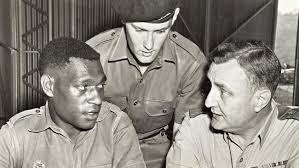
Those that would probably have a clear recall of PNG independence are the surviving "Chalkies", those national servicemen who became part of the Army Education Corps tasked with providing educational programmes for members of the PNG Pacific Islands Regiment between 1966 and 1973. 

Darryl Dymock, a nasho who was in my recruit platoon at Singleton in 1969, has written a very engaging book about these three hundred or so diggers. One of the themes explored in that work is the contribution these men made to the peaceful transfer of power in PNG, a country that many considered to be at risk of succumbing to violence during this period of transition.

I would gladly have been one of them, but the army obviously believed at the time that I would make a better contribution in Infantry.

The PIR had a strong role in maintaining law and order in this somewhat boisterous country, and the values and protocols instilled in its members through their education at the hands of young Australian teachers was important.

Perhaps this small piece of history can (excuse the pun) teach us something if we consider the tensions surrounding recent events in the Solomons. Maybe if Australia had set out, through a range of initiatives, to strengthen the political and cultural institutions in the island nation during the last couple of decades, as it did in PNG between 1966 and 1973, we would not have landed (with a thud) where we are now.

Denise Fisher's 2014 piece in The Interpreter echoes, to some extent, this sentiment, and notes the degree to which France regards the significance of the status of New Caledonia to its influence in the Pacific, and bankrolls it accordingly. I have stolen the title of her piece and applied it to this post, as it's a good fit.

Perhaps we could learn something from the French, or (perish the thought) the Chinese.


Comments closed.


Saturday, 30 April 2022

What Goes Round.....

Image from Queensland Government Archives

Between 1863 and 1904 about 60,000 Pacific islanders were transported to the then colony of Queensland, where they were put to work creating sugar plantations. The Islanders were generally coerced to board the traders' ships, and were often paid in trinkets for their labour, because, as one prominent blackbirder was reported as saying - "These people are savages and have no understanding of the value of money".

The mortality rate for these Islanders was about 30%, not dissimilar for African slaves to the Americas. You can read the history and make up your own mind as to whether these men were conscripted labourers or slaves.

By the 1870s, "recruiting" of South Sea Islanders had become an established industry with labour vessels from across eastern Australia obtaining Kanakas (the term used for South Sea Islanders, a term now considered offensive) for both the Queensland and Fiji markets. many of these people came from the Solomons.

Legislation was passed to end the South Sea Islander labour trade in 1890 but it was not effectively enforced. Eventually, the Pacific Island Labourers Act 1901 (part of a larger White Australia Policy), made it illegal to import South Sea Islanders During the period when Blackbirding persisted, thousands of these workers died, either on the voyages to Queensland, or after arrival, often as a consequence of diseases and the conditions.

As a child growing up in North Queensland in the fifties, I went to school with the descendants of these people, some of whom remained after the trade was outlawed, and made lives for themselves in the areas where sugar was grown. They were usually pretty good footballers. Mal Meninga was one notable example.

A memorial has been built at Corser Street, Polson Cemetery, Point Vernon, in Hervey Bay, to commemorate this dark history.

It's hardly remarkable, in the light of this history, that the people of the Solomons (or at least their government) aren't head over heels in love with Australia. Perhaps this history is one of many factors which conspired to encourage the Solomons to sign a security agreement with China.

Somehow, in the middle of the controversy and outrage, these events have been completely forgotten by most Australians.

I very much doubt the Solomon Islanders (and many other descendants of the Islanders who were indentured from other parts of the Pacific) have forgotten them.


Tuesday, 19 April 2022

Toxic Disinformation


Pic courtesy The Guardian

The other day, gentle reader, I worked out that I have participated (or attempted to participate) in twenty federal elections since 1969.

The first one in 1969 was notable in that whilst at age 21 I was old enough to vote in that election I never did, as I was refused leave from Canungra Jungle Training Centre to do so. I was threatened with a charge of being AWOL if I left the base to vote.

This was particularly frustrating as I was training to fight (in peacetime) in South Vietnam as a conscript, and felt I was entitled to have a say in my immediate future. Labor policy at the time was to abolish conscription. I did end up in Vietnam, and had to wait until 1972 to see that policy implemented.

Through all those elections, I have never observed such an avalanche of disinformation about the forthcoming ballot that I'm observing now, most of it emanating from the lunatic fringe of social media, which has oozed across the Pacific.

It has its origin in Donald Trump's big lie, and has been promoted by every disaffected group that coalesced during the pandemic and government attempts, through the health system, to manage it.

The Australian Electoral Commission has found it necessary to develop a web page specifying many of those slabs of disinformation and fact checking them.

For example, these are some of the dark whispers doing the rounds -

There will be two federal elections in 2022 including the People's non-corporate commonwealth election.

And

Dominion voting machines will be used and will be rigged to favour one of the major political parties.

And

Postal voting is not secure and people should deregister.

The ludicrous nature of this disinformation should make it completely apparent to anyone with any knowledge of this country's electoral system that it is toxic nonsense, but there are those who actually believe it.

This Youtube video explains pretty clearly (albeit with a tongue-in cheek approach) why our system is the best in the world.

Democracy is an exercise in participation. In this country it is encouraged. 

That's important. I remember very well what happened in 1969.


Thursday, 14 April 2022

Time for an Apology


Pic Courtesy Adelaide Now*

The following letter, gentle reader, has been emailed to all candidates in my federal electorate.

It will be interesting to see what responses I get, if any.

I'll keep you posted.


*This picture, from the AWM archive, was used to illustrate an article by Grahame Cornes, a member of my rifle platoon, in Adelaide Now on Dec 4th 2020.

Note - The links don't work in the letter.
Find them here.

Update 15.04.22 - Genevieve Allpass, Suzie Holt and Garth Hamilton (who says he will take it up with the minister) have responded. If Hamilton is fair dinkum, he'd be taking it up with the PM. After all, the PM is one of the two people (the other is the Leader of the Opposition) who should be making the apology.

Monday, 11 April 2022

Kilcullen on Ukraine and Other Things


Pic courtesy Wikipedia

Dr David Kilcullen is a commentator for whom I hold a great deal of respect, if for no other reason that he called the invasion of Iraq "f**king stupid".

History, of course, proved him correct.

I'll depart from the usual convention that I follow on this blog, gentle reader, and simply link you to a recent  podcast of a talk that Kilcullen had with Peter Jennings of the Australian Strategic Policy Institute, rather than sharing my own (comparatively uninformed) opinion.

It's well worth a listen. 


Wednesday, 6 April 2022

It's Broke

Pic courtesy Caterina Sullivan 

There's an old saying, gentle reader, which goes something like this - "If it ain't broke, don't fix it". When it comes to the state of Australian politics, I believe it is indeed "broke". 

You don't have to look very far to understand the level of this dysfunction. 

Where do I start? 

Young people can't buy homes, they are exploited by their employers because of the power imbalance created by the fading union movement, and even when employed, their jobs are often insecure and they haven't seem a wage rise in their living memories. 

At the other end of the age spectrum, our elderly are languishing in "Nursing" homes (without nurses), being fed baked beans, and dying from Covid because their paid carers have to work across a number of institutions to make ends meet whilst transmitting the virus from one site to another like pollinating bees. 

At the same time, our political class, irrespective of party affiliation, is rife with corrupt practice, blatant cronyism, and bereft of any semblance of much needed reform. 

Remember "reform"? 

That was stuff that happened when we had leaders like Hawke and Keating. 

Perhaps this situation is the culmination of a slowly developing distortion of our system of government, which was not based on party affiliations, and the power of those mechanisms, but on the notion of a local representative caring for the needs of his/her constituents. The membership of these parties, although it is improving, is still not reflective of the communities they claim to represent, no matter whether gender, race, sexuality or identity is considered. 

 Even the selection of these candidates, as we have seen recently, is a top-down process, usually controlled by the party apparatchiks.  

It's not incorrect to claim that the interests of the parties, through the power they wield, is always placed ahead of the interests of the constituents. When you think about it, this is an inevitable trend, if only to ensure the survival in power of whatever party we're considering. 

A more recent phenomenon, that of oligarchs taking advantage of this dysfunction to coerce voters through their extravagant spending in the media by the fulmination of lies and misinformation, is even more sinister. 

We have only to look across the Pacific to understand the consequences. 

So it is "broke". 

 How do we fix it? 

 Obviously, the quality and motives of the candidates is vital. 

We need the best and the bravest. 

They won't be found using branch-stacking, factional warfare and grooming political advisers as they rise through the ranks of the party. 

 Often they self-identify. Some of our best independent politicians have emerged simply as a result of their authenticity and courage. Ted Mack and Peter Andren are examples. 

 So I'll be looking at the quality of the candidates in my electorate when the PM visits Yarralumla, which could happen as soon as today. 

To be honest, none of them are actually inspiring

Groundhog Day

M109 at the Horseshoe Back in May 1970, I was a reluctant member of 5 platoon, B Coy, 7 RAR, and about one third into my sojourn in South Vi...